
British Honey
British Honey vs Spanish Raw Honey: Quality, Scale & Truth Revealed
Introduction
Honey may appear simple — a natural sweetener produced by bees — yet behind every jar of raw honey lies a complex system of climate, forage diversity, bee health, extraction facilities, laboratory testing, and trade regulations. Comparing British honey with Spanish honey is not just a matter of flavour preference. It is a comparison between two distinct agricultural systems, production scales, and approaches to handling raw honey quality, authenticity, and traceability.
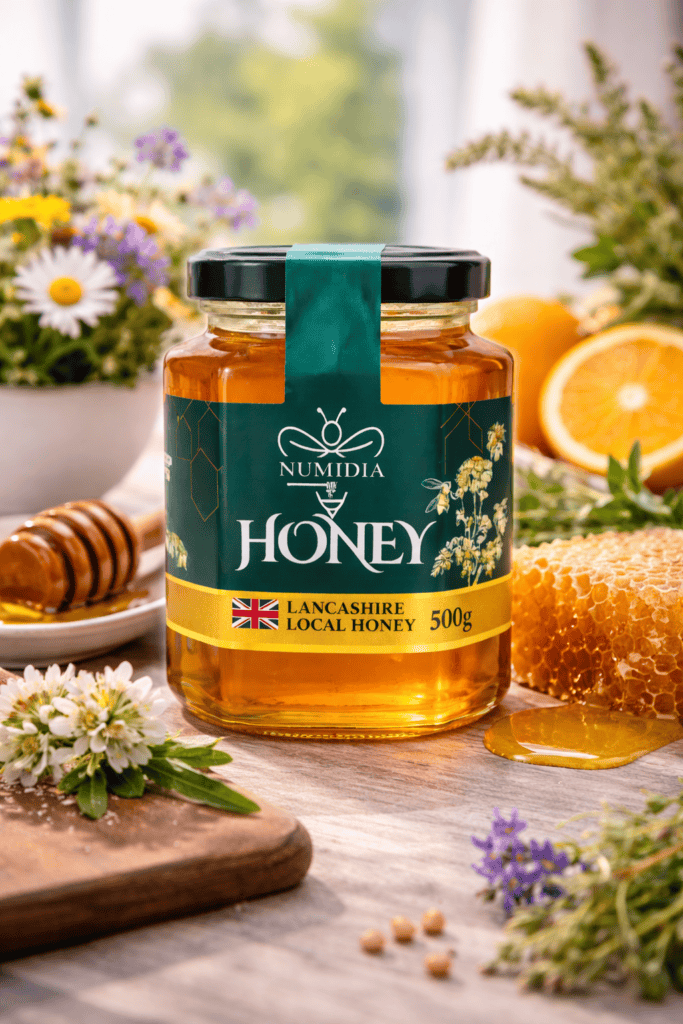
If you are looking for premium British honey produced in small batches with full traceability, you can explore our Lancashire wildflower honey jar sourced from Lancashire.
This article examines both countries scientifically and economically, focusing on:
- Production quantity
- Colony numbers
- Floral diversity
- Raw honey quality indicators
- Facilities and processing systems
- Authenticity controls
- Regulatory developments
1. Production Quantity: A Major Difference in Scale
Spain is one of Europe’s largest honey producers. According to European agricultural data and trade analysis, Spain produces approximately 30,000–35,000 tonnes of honey annually, depending on seasonal conditions.
Eurostat trade data confirms Spain as one of the EU’s leading honey exporters:
https://ec.europa.eu/eurostat/web/products-eurostat-news/w/ddn-20240520-1
By contrast, the United Kingdom produces significantly less honey — typically 5,000–7,000 tonnes per year, depending heavily on weather and nectar flow conditions.
The UK imports large volumes of honey to satisfy consumer demand. The British Beekeepers’ Association references substantial annual imports, demonstrating that domestic production covers only part of national consumption:
https://www.bbka.org.uk/bbka-national-honey-day
What this means:
- Spain operates at industrial and export scale.
- The UK functions as a premium local production market.
- British honey is often limited in availability.
- Price positioning differs due to supply constraints.
Scale does not determine quality, but it shapes market structure.
2. Colony Numbers and Beekeeping Structure
Spain maintains nearly 3 million honey bee colonies, supporting a highly professionalised sector. Academic data on European beekeeping highlights Spain’s strong commercial base:
https://pmc.ncbi.nlm.nih.gov/articles/PMC11871193/
The United Kingdom has approximately 250,000–300,000 registered hives, according to the UK National Bee Unit:
https://www.nationalbeeunit.com/bees-and-the-law/hive-count
This structural difference influences:
- National output
- Monofloral production capacity
- Export readiness
- Facility scale
Spain’s high colony numbers support consistent commercial supply. The UK has many small and medium-scale beekeepers, often selling directly to consumers.
3. Floral Diversity and Honey Types
Spain: Broad Monofloral Range
Spain’s Mediterranean and continental climate zones enable extended nectar seasons and strong dominant flowering periods. Common Spanish honey types include:
- Rosemary
- Thyme
- Orange blossom
- Chestnut
- Eucalyptus
- Heather
The country’s geography allows large-scale production of identifiable monofloral honeys.
United Kingdom: Seasonal and Localised Profiles
British honey is often polyfloral (wildflower), shaped by:
- Clover
- Bramble
- Lime
- Hedgerows
- Gardens
- Heather (in specific upland regions)
The UK produces fewer large-scale monofloral categories nationally but offers strong locality-driven flavour variation.
4. Raw Honey: Scientific Quality Markers
The term raw honey should relate to measurable handling standards rather than marketing language.
According to the Codex Alimentarius Commission (CXS 12-1981), internationally recognised standards define the compositional criteria, safety thresholds, and labelling expectations for honey in global trade.
Official document: FAO/WHO Codex Honey Standard
https://www.fao.org/fao-who-codexalimentarius/
Key Laboratory Indicators
1. Moisture Content
Lower moisture reduces fermentation risk.
2. HMF (Hydroxymethylfurfural)
Higher HMF can indicate overheating or long storage. Eurofins outlines honey quality testing parameters including HMF measurement:
https://cdnmedia.eurofins.com/european-west/media/12153881/10_chapter-honey_final.pdf
3. Diastase Activity
An enzyme indicator that decreases with heat.
4. Pollen Spectrum
Used to verify botanical and geographical origin.
If you are looking for small-format tasting jars of gently handled raw honey, see:
https://numidiakingdom.co.uk/product/28g-honey/
Quality is determined by harvesting practices, extraction temperature, filtration method, and storage — not nationality.
5. Facilities and Processing Infrastructure
Facilities influence hygiene, consistency, and traceability.
United Kingdom
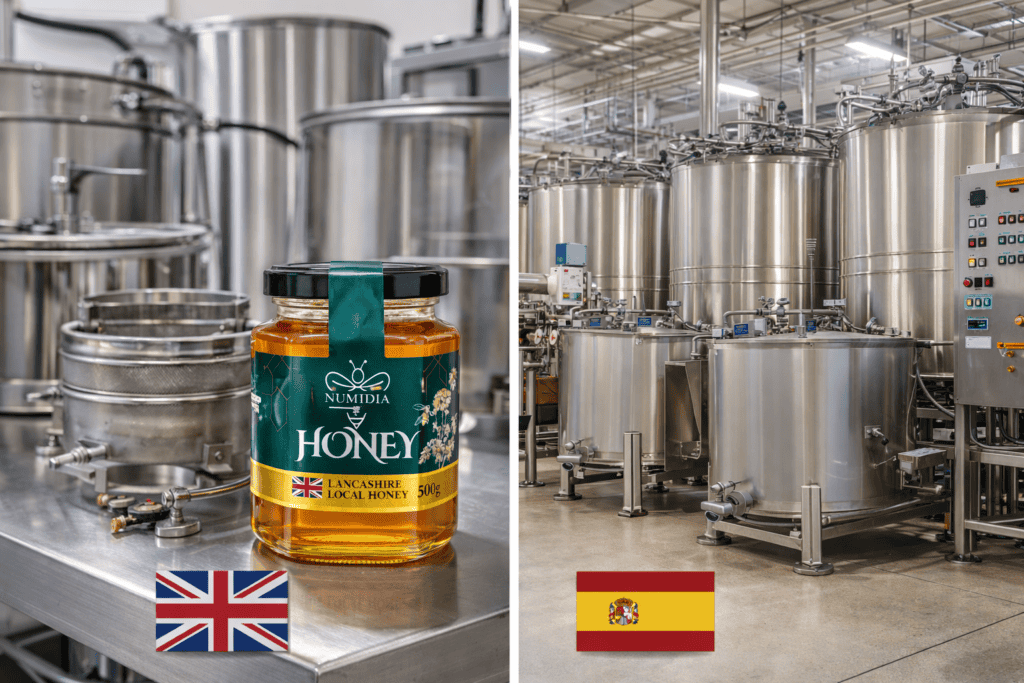
Typical UK extraction setup includes:
- Stainless steel extractors
- Uncapping trays
- Double filtration sieves
- Settling tanks
- Direct jarring systems
Many UK producers operate short supply chains: beekeeper → jar → consumer.
Because the UK imports large quantities of honey, authenticity monitoring is critical. The UK Food Standards Agency has published research on honey authenticity challenges and testing innovation:
https://www.food.gov.uk/research/honey-authenticity-introduction-exploring-the-authenticity-challenge
Spain
Spain’s industry includes:
- Large migratory operations
- Centralised packing facilities
- Bulk storage tanks
- Export-grade logistics systems
Spain’s capacity supports EU and non-EU exports.
EU origin labelling rules are being strengthened under Directive (EU) 2024/1438 to improve transparency in blends:
https://eur-lex.europa.eu/EN/legal-content/summary/eu-labelling-rules-for-honey.html
6. Authenticity and Adulteration Risk
Honey is a high-value product vulnerable to adulteration with sugar syrups.
Modern testing techniques include:
- Stable isotope analysis
- Nuclear magnetic resonance (NMR)
- Advanced sugar profiling
The UK Food Standards Agency continues to develop improved methodologies:
https://science.food.gov.uk/article/124522-developing-a-new-testing-methodology-for-honey-authentication
Consumers should avoid labels that state only:
“Blend of EU and non-EU honeys”
Instead, choose honey with clear origin.
7. Price and Market Structure
Spain’s scale enables:
- Lower per-kilogram production costs
- Strong export competitiveness
- Wide supermarket presence
British honey tends to be:
- Higher priced
- Limited supply
- Premium-positioned
- Often sold directly
For culinary pairing ideas, especially combining honey with vinegar for dressings or marinades, see:
https://numidiakingdom.co.uk/product/numidia-honey-vinegar-250ml/
8. Sensory Profile Comparison
British Honey
- Floral
- Fresh
- Often light amber
- Seasonal variation
- Influenced by mixed forage
Spanish Honey
- Strong monofloral character
- Thyme: herbal and aromatic
- Chestnut: dark and bold
- Orange blossom: delicate and citrus-like
Spain provides broader national flavour segmentation; the UK offers more local terroir-driven variation.
9. Sustainability Context
Both countries face:
- Varroa mite pressure
- Climate variability
- Habitat loss
- Market adulteration challenges
Spain’s scale supports agricultural pollination across vast areas. The UK’s hedgerow system and small apiaries support biodiversity on a micro-regional level.
Conclusion
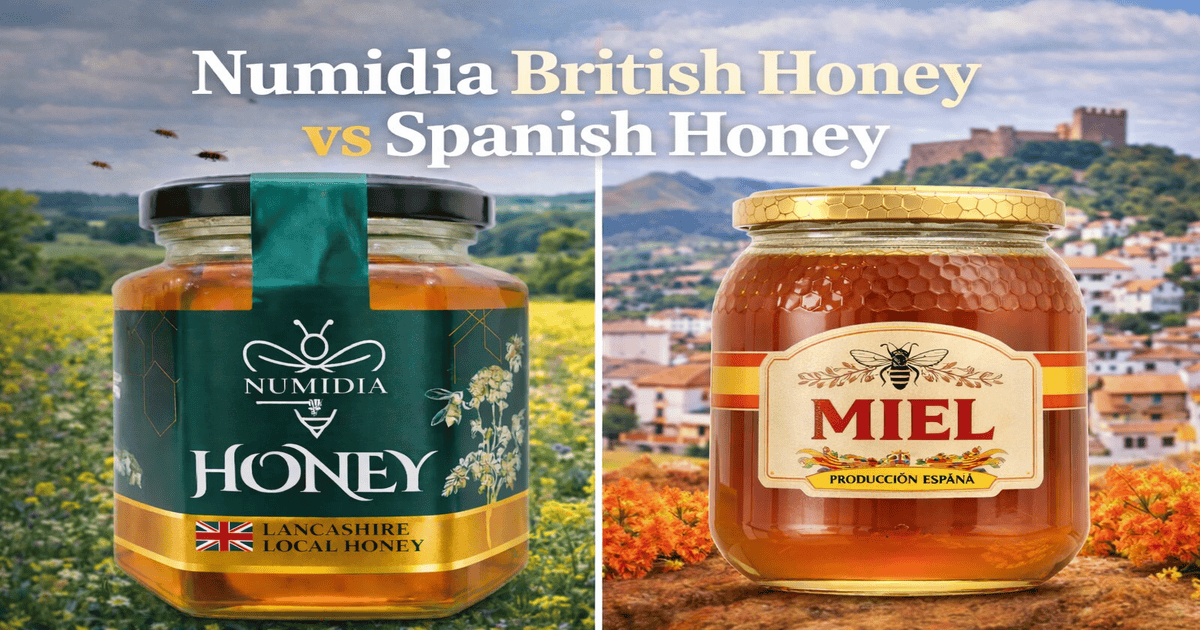
Scientifically, neither country is inherently superior.
Spain dominates in:
- Production volume
- Colony numbers
- Monofloral diversity
- Export capacity
The United Kingdom stands out in:
- Short supply chains
- Local traceability
- Seasonal character
- Premium positioning
When selecting british honey or Spanish honey, focus on:
- Clear country of origin
- Moisture control
- Low heat exposure
- Authenticity testing
- Transparent labelling
The highest-quality raw honey will always be defined by handling standards and integrity — not by geography alone.
