British Honey
Premium British Honey vs Supermarket Honey: The Truth About Pure Honey in the UK
In today’s market, consumers searching for Premium British Honey often face a confusing choice between artisan jars and low-cost supermarket bottles. At the same time, interest in Pure Honey UK has grown significantly as buyers become more aware of food authenticity, processing standards, and import transparency. But what is the real difference between premium British honey and supermarket honey? And does price truly reflect quality?
This article provides a scientific, evidence-based comparison of sourcing, purity testing, nutritional value, industry standards, and long-term sustainability within the UK honey sector.
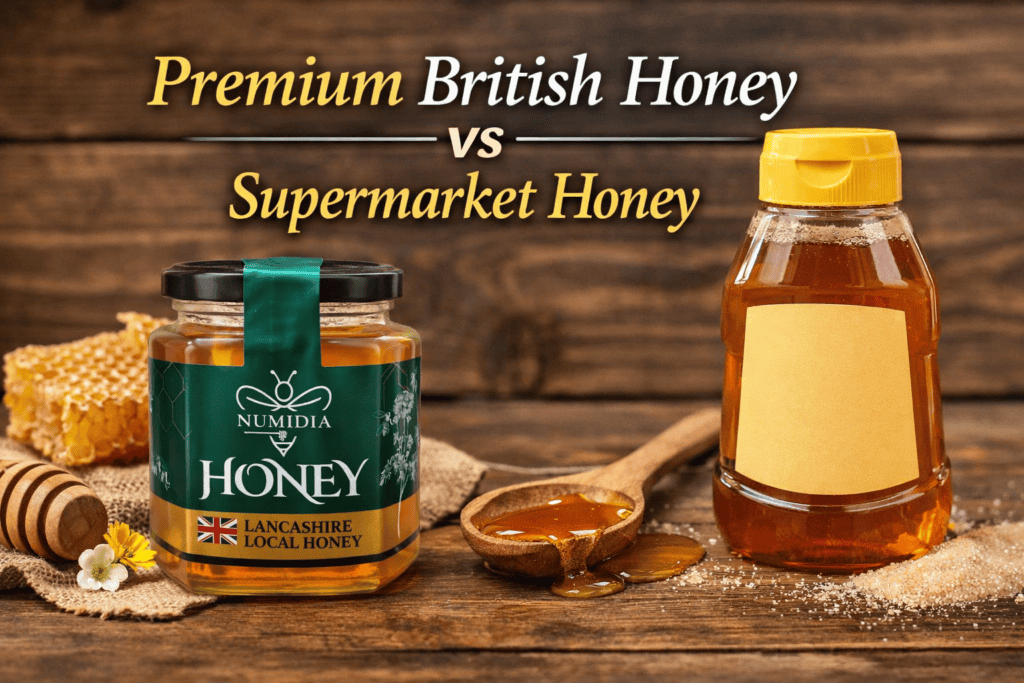
What Is Premium British Honey?
Premium British Honey refers to honey:
- Produced by UK beekeepers
- Harvested from local floral sources
- Minimally processed
- Not blended with imported honey
- Fully traceable to apiary origin
In the UK, honey labelled as “British” must comply with the Honey (England) Regulations 2015:
https://www.legislation.gov.uk/uksi/2015/1348/contents/madePremium producers often go further than legal minimums. They:
- Avoid ultra-filtration
- Do not overheat honey
- Preserve natural enzymes such as diastase
- Maintain pollen integrity
Unlike industrial honey, premium honey reflects the floral biodiversity of the British landscape — wildflower meadows, clover fields, hedgerows, and seasonal blossoms.
For example, authentic British wildflower honey is typically harvested in limited batches and extracted using low-temperature methods to protect its natural properties.
What Is Supermarket Honey Really?
Supermarket honey varies widely.
Many low-cost options are:
- Imported blends from multiple countries
- Heat-treated for longer shelf life
- Ultra-filtered for visual clarity
- Blended to standardise flavour
The UK imports a significant proportion of its honey supply. According to DEFRA:
https://www.gov.uk/government/statistics/beekeeping-and-honey-statisticsThe UK produces only a fraction of its annual consumption, meaning large volumes come from outside Europe.
Imported honey is not automatically inferior. However, blending practices reduce traceability. Labels such as “Blend of EU and non-EU honeys” provide limited information about origin or floral source.
Ultra-filtration removes pollen — which makes origin verification difficult.
Premium British Honey and Traceability Standards
One of the defining characteristics of Premium British Honey is traceability.
Authentic UK producers can usually provide:
- Apiary location
- Harvest season
- Floral source
- Batch number
Traceability matters because honey fraud is a global issue. The European Commission has reported significant concerns about honey adulteration:
https://food.ec.europa.eu/food-safety/food-fraud-and-quality/food-fraud_enRecent EU coordinated testing found a high proportion of imported honey samples suspected of non-compliance with authenticity standards.
Premium British honey reduces this risk through local accountability and shorter supply chains.
Pure Honey UK: What Does “Pure” Actually Mean?
The term Pure Honey UK legally means honey that:
- Has no added sugar syrups
- Has no artificial flavourings
- Is not diluted
According to the UK Honey Regulations, honey must not contain added ingredients.
However, purity goes beyond legality.
Scientifically, pure honey maintains:
- Natural glucose and fructose balance
- Enzyme activity (diastase number)
- Low HMF (hydroxymethylfurfural) levels
- Intact pollen spectrum
The Codex Alimentarius sets international honey quality standards:
https://www.fao.org/fao-who-codexalimentarius/codex-texts/list-standards/en/Premium honey typically exceeds minimum requirements.
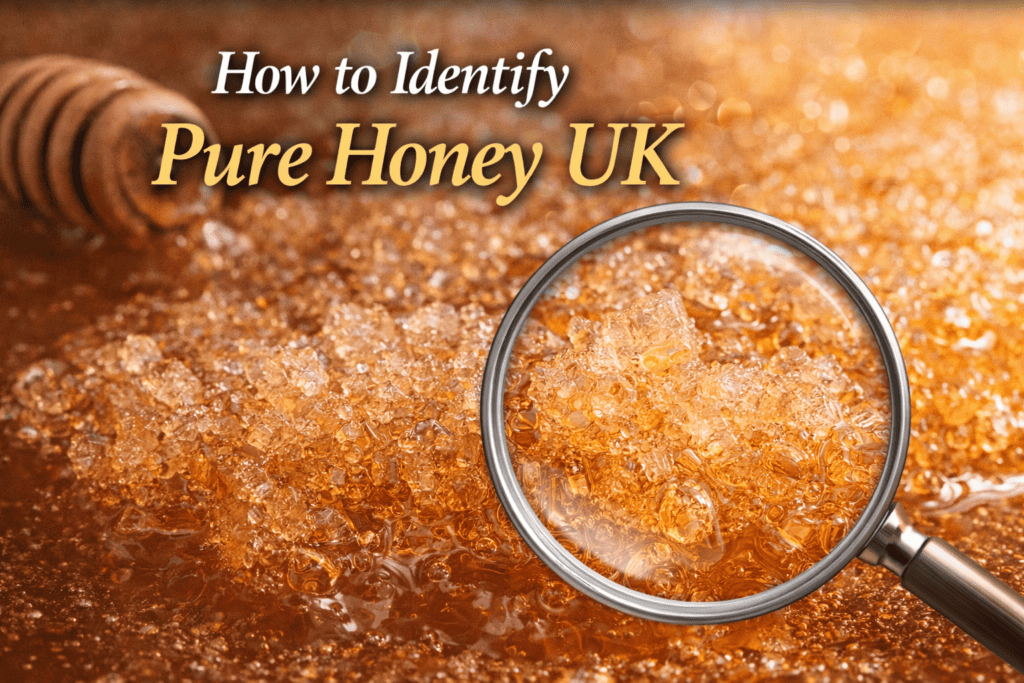
Premium British Honey and Nutritional Integrity
Scientific research confirms that minimally processed honey retains more bioactive compounds.
Raw honey contains:
- Antioxidants (phenolic compounds)
- Enzymes
- Trace minerals
- Amino acids
A review published in the National Library of Medicine highlights honey’s antioxidant and antimicrobial properties:
https://www.ncbi.nlm.nih.gov/pmc/articles/PMC5424551/Excessive heating can:
- Reduce enzyme activity
- Increase HMF levels
- Alter flavour compounds
Premium British honey is usually gently warmed only enough to allow bottling, preserving nutritional quality.
How Premium British Honey Differs in Processing
1. Temperature Control
Premium honey:
- Heated minimally (often below 40°C)
Supermarket honey:
- May be heated higher for industrial filtration
2. Filtration
Premium honey:
- Strained, not ultra-filtered
- Retains pollen particles
Supermarket honey:
- Often micro-filtered for clarity
3. Batch Size
Premium honey:
- Small batch
- Seasonal variability
Supermarket honey:
- Large blended volumes
- Standardised taste
Premium British Honey and Cost: Why Is It More Expensive?
The higher price of Premium British Honey reflects:
- Limited UK harvest volumes
- Weather dependency
- Higher labour costs
- Small-scale extraction
- Glass jar packaging
- Local compliance standards
UK honey production fluctuates yearly due to weather patterns.
According to the British Beekeepers Association:
https://www.bbka.org.ukSeasonal variation can significantly impact national yields.
Unlike mass imports, UK honey cannot be produced at industrial scale without compromising environmental sustainability.
Pure Honey UK vs Imported Blends
Imported honey is often blended to achieve:
- Consistent colour
- Standard sweetness
- Lower price
However, blending reduces:
- Regional identity
- Floral uniqueness
- Pollen traceability
Premium British honey offers a direct link to UK landscapes.
Consumers seeking authentic Pure Honey UK increasingly value transparency over price.
Premium British Honey and Authenticity Testing
Modern honey authentication uses:
- Isotope ratio mass spectrometry
- Nuclear magnetic resonance (NMR)
- Pollen analysis (melissopalynology)
These tests detect sugar syrup adulteration and origin inconsistencies.
The European Joint Research Centre has published findings on honey authenticity concerns:
https://joint-research-centre.ec.europa.euPremium UK producers benefit from short supply chains, reducing fraud risk.
Environmental Impact of Premium British Honey
Supporting Premium British Honey strengthens:
- Pollination services
- Biodiversity
- Local agriculture
Bees contribute billions annually to global crop pollination.
The UK National Pollinator Strategy outlines the ecological importance of supporting bee populations:
https://www.gov.uk/government/publications/national-pollinator-strategy-for-bees-and-other-pollinators-in-englandPurchasing local honey supports environmental sustainability directly.
Premium British Honey and Flavour Complexity
Unlike standardised blends, premium honey reflects:
- Clover dominance
- Wildflower diversity
- Seasonal nectar variation
Flavour profiles can include:
- Floral notes
- Herbal tones
- Light caramel hints
- Subtle acidity
This natural variation indicates authenticity rather than inconsistency.
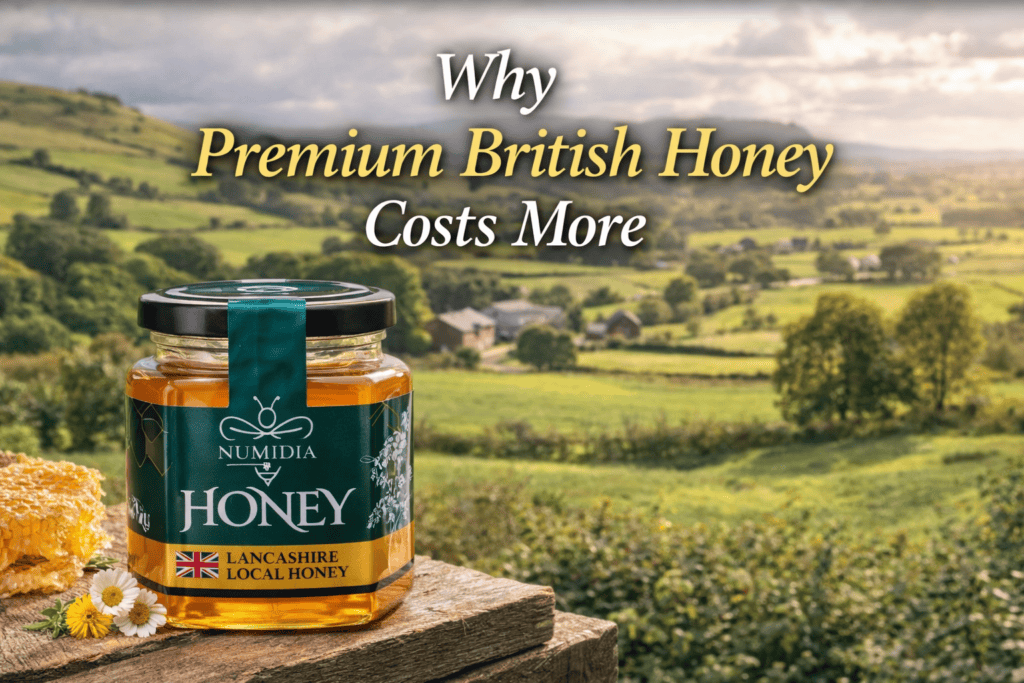
Is Supermarket Honey Bad?
Not necessarily.
Supermarket honey:
- Meets legal standards
- Is safe for consumption
- Is affordable
However, it may prioritise:
- Visual clarity
- Shelf life
- Cost efficiency
Rather than:
- Nutritional preservation
- Local identity
- Floral diversity
The difference lies in production philosophy.
Premium British Honey and Consumer Trust
Trust is built through:
- Transparent sourcing
- Clear labelling
- Honest production methods
Consumers increasingly search for:
- Premium British honey online
- Pure honey UK producers
- Raw honey near me
This shift reflects greater awareness of food authenticity issues.
Internal Resources for Pure Honey UK Buyers
If you want to explore authentic British honey products:
Premium British Wildflower Honey 500g:
https://numidiakingdom.co.uk/product/numidia-wildflower-honey-500g/Mini 28g British Honey Jars:
https://numidiakingdom.co.uk/product/28g-honey/Honey Vinegar 250ml:
https://numidiakingdom.co.uk/product/numidia-honey-vinegar-250ml/Educational blog section:
https://numidiakingdom.co.uk/category/british-honey/
Final Verdict: Premium British Honey or Supermarket Honey?
Choose supermarket honey if:
- Price is your primary concern
- You need large quantities at low cost
Choose Premium British Honey if you value:
- Traceability
- Local production
- Nutritional preservation
- Environmental sustainability
- Authentic flavour
For consumers seeking genuine Pure Honey UK, supporting local producers ensures quality, accountability, and long-term industry resilience.
CONCLUSION
The difference between Premium British Honey and supermarket honey is not marketing exaggeration. It lies in sourcing, processing, traceability, environmental impact, and nutritional preservation.
As awareness of food authenticity grows, more UK consumers are prioritising transparency over price. The future of the British honey industry depends on informed buyers who understand what true purity means.
When you choose premium British honey, you are not only purchasing a sweetener. You are investing in:
- Local biodiversity
- British agriculture
- Ethical beekeeping
- Long-term sustainability
