
British Honey Industry
British Honey Prices in the UK: Full Guide (2026)
Introduction
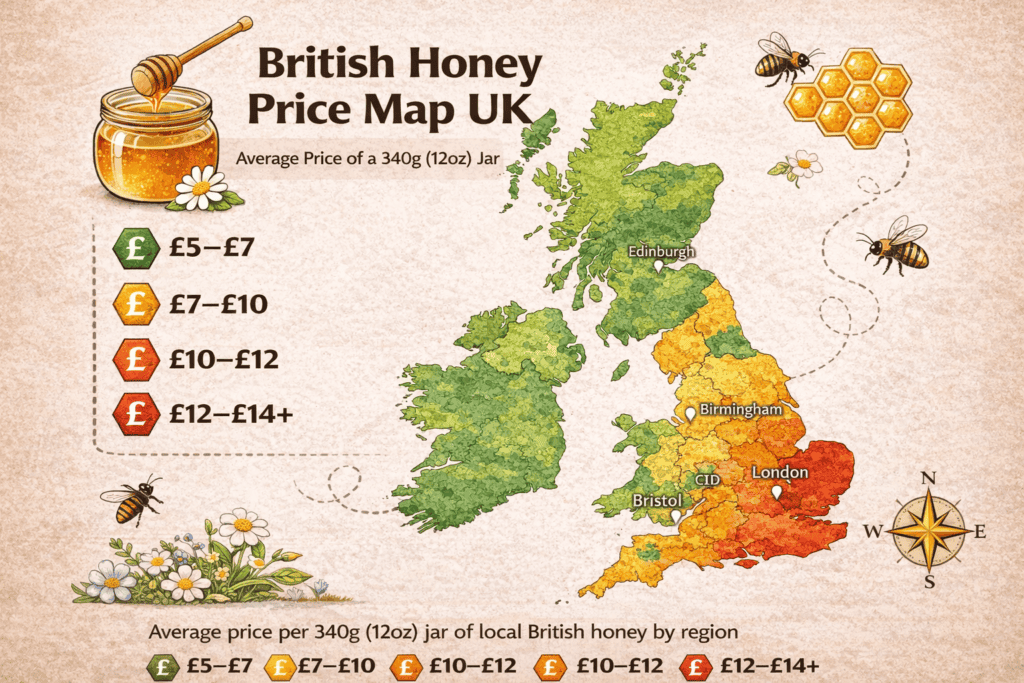
Walk into any farmers’ market, farm shop, online store, or local honey stall in the UK and you’ll quickly notice something surprising: British honey price is never the same. One beekeeper may sell a 340g jar for £5, while another only a few miles away sells the same size for £10–£12. In London and the South East, the same jar may reach over £14. Meanwhile, in rural areas, hobbyists often sell for so little that their price does not even cover their production costs. These differences are a clear reflection of how diverse and inconsistent the UK honey market can be from one region to another.
To the average customer, this can seem confusing. Honey is honey, right? But to beekeepers—and especially to anyone who understands the UK honey market—these price differences make perfect sense.
This article explains why British honey prices vary across the UK, why many hobby beekeepers often underprice their honey, and how local factors such as forage availability, hive health, regional costs, environmental pressures, and business structure all affect pricing.
Why British Honey Price Varies Across the UK
Walk into any farmers’ market, farm shop, online store, or local honey stall in the UK and you’ll quickly notice something surprising: British honey price is never the same. One beekeeper may sell a 340g jar for £5, while another only a few miles away sells the same size for £10–£12. In London and the South East, the same jar may reach over £14. Meanwhile, in rural areas, hobbyists often sell for so little that their price does not even cover their production costs. These differences highlight how complex and inconsistent the UK honey market can be from one region to another.
How Forage Conditions Influence British Honey Price
The availability of nectar sources—wildflower meadows, parks, farmland, and urban gardens—strongly impacts honey yields. Regions with rich floral diversity produce more honey, while areas with limited forage see poor harvests. These forage differences shape the UK honey market and directly influence the British honey price across the country.
Weather Patterns and Their Impact on British Honey Price
Climate and seasonal weather patterns play a major role in how often bees can fly, forage, and process nectar. Cold, wet, or windy weather restricts foraging activity, reducing honey yields for the entire season. These weather-driven fluctuations influence the UK honey market, creating noticeable changes in British honey price from one region to another.
Why Local Costs Shape the British Honey Price
Fuel prices, jars, labels, equipment, apiary rent, and insurance vary significantly across the UK. Beekeepers in high-cost regions must charge more to cover expenses, while those in low-cost areas may be able to sell for less. These regional economic pressures affect the UK honey market and contribute to the wide variation in British honey price nationwide.
1. Why British Honey Price Is Not the Same Across the UK
The UK is a relatively small island, but the environment, climate, and forage quality vary dramatically from region to region. This means honey production—and therefore price—can differ substantially.
Let’s break down the primary factors.
1.1 Forage Conditions: Not All Regions Have Equal Nectar Sources
The amount of nectar available determines the amount of honey each hive can produce. Some regions naturally have better forage.
Regions with consistently strong forage
- South East England – long season, mild climate
- London – excellent urban forage diversity (street trees, parks, gardens)
- Somerset, Devon, Cornwall – long flowering season
- Cambridgeshire/Lincolnshire – oilseed rape (OSR) crops boost yields
Regions with limited or inconsistent nectar flows
- Scotland – short summers
- Wales – high rainfall limits nectar availability
- Northern areas – later bloom, shorter nectar windows
- Intensive farmland – monocultures limit diverse nectar sources
Better forage = higher honey yields = lower per-jar production costs.
Poor forage = lower yields = higher jar costs.
This is one of the biggest factors behind the inconsistent British honey price.
1.2 Climate, Weather, and Seasonal Variability
Rain reduces bee foraging activity. Cold and wind restrict flight. Dry conditions reduce nectar production.
This means:
- A beekeeper with a perfect season may harvest 50–80 lbs per hive
- Another, only 20 miles away, may harvest 10–15 lbs per hive
This huge yield difference directly impacts jar pricing.
1.3 Regional Demand vs. Supply
The UK has very different honey supply profiles:
- London demand is extremely high, supply low → higher prices
- Rural areas produce more honey but have fewer customers → lower prices
- Tourist-heavy regions (e.g., Lake District, Cotswolds) command higher prices
- Regions with large numbers of hobby beekeepers often have market oversupply
Where supply is low and demand high, British honey price naturally increases.
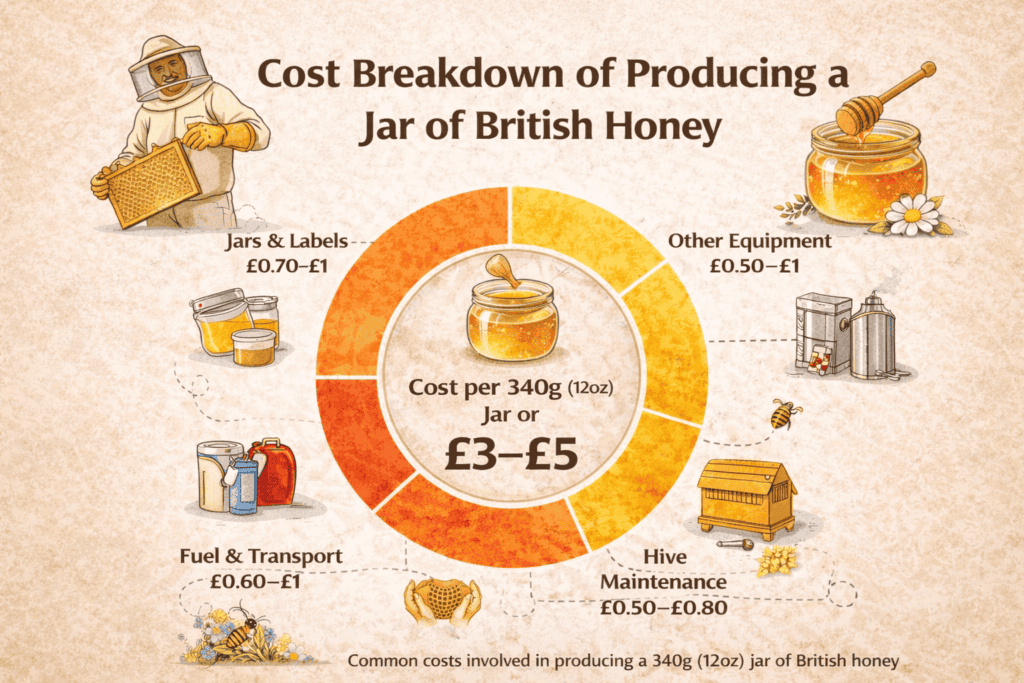
1.4 Variation in Beekeeping Costs Across the UK
Costs differ by region:
| Category | High Cost Regions | Low Cost Regions |
|---|---|---|
| Jars, lids, labels | London, South East | Midlands, North |
| Fuel & transport | Rural Scotland, Wales | Urban areas |
| Insurance | South East | North of England |
| Labour (if hired) | London & Home Counties | Scotland & Northern areas |
| Hive sites / rent | London most expensive | Wales / North cheapest |
Different cost structures = different honey prices.
1.5 Local Honey Branding and Perception
Some regions are seen as premium honey regions, such as:
- Heather honey from Scotland or Yorkshire
- Kent honey (Garden of England)
- London honey (luxury urban brand)
- Cotswold honey (tourist premium)
Where brand perception is high, prices naturally rise.
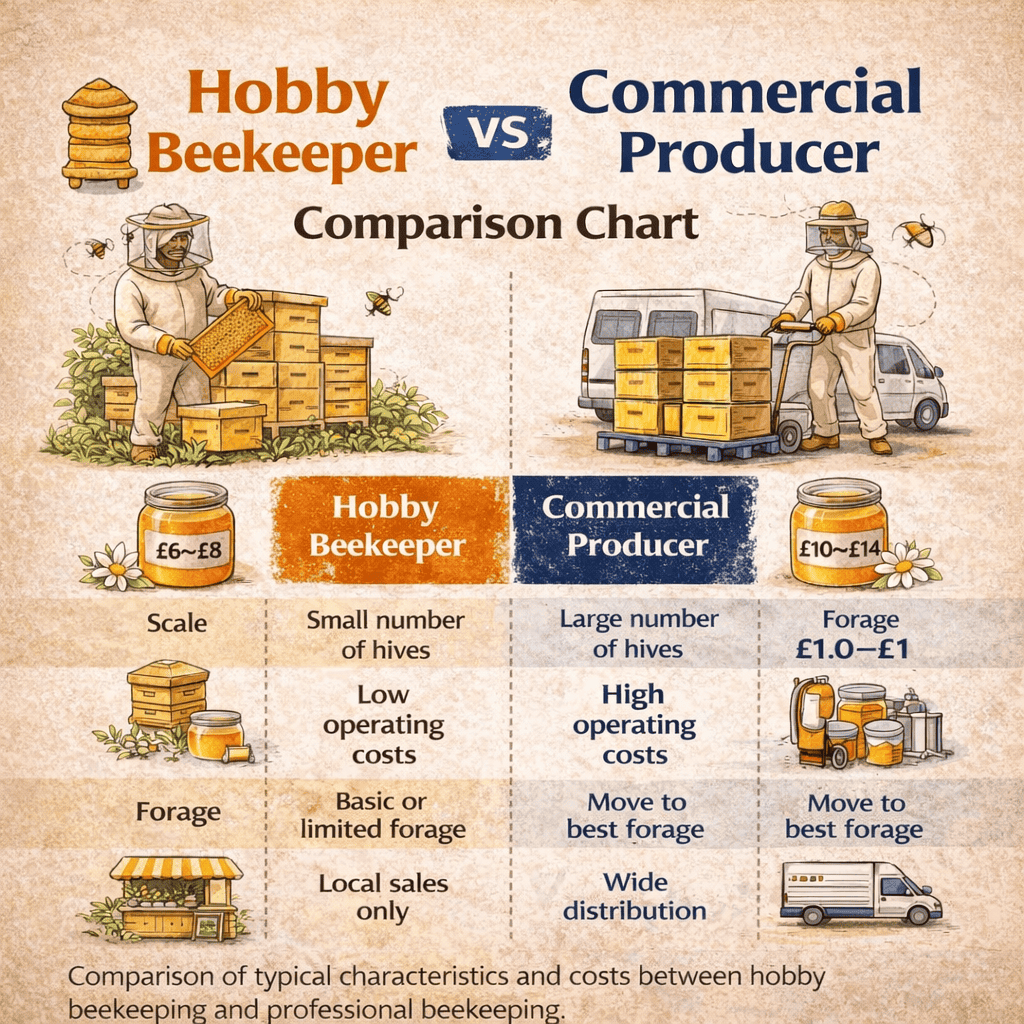
2. Why Hobby Beekeepers Often Underprice Their Honey
This is one of the biggest and most misunderstood issues in the UK honey market.
Many hobbyists sell honey below cost.
Let’s explore why.
2.1 They Don’t Calculate Costs Properly
Most hobbyists don’t treat beekeeping as a business.
They focus on:
- enjoyment
- local pollination
- giving honey to friends
- maintaining a few hives as a passion
But even small-scale beekeeping has real costs:
- Hive equipment (£350–£600 per hive)
- Tools, suits, smokers, frames
- Sugar syrup feeding (especially autumn & spring)
- Varroa treatments & medications
- Jars, lids, and labels
- Fuel travelling to apiary
- Insurance and association fees
When these costs are added together, many hobbyists spend £300–£500 per year per hive but sell honey for £4–£6 per jar—far below sustainable levels.
2.2 They Fear Charging “Too Much”
Hobby beekeepers often worry:
- “What if customers think I’m greedy?”
- “My honey shouldn’t cost more than supermarket honey.”
- “People expect local honey to be cheap.”
This mindset pushes prices downward, despite the premium nature of real British honey.
2.3 They Don’t Consider Labour Costs
Extracting honey involves:
- filtering
- uncapping
- spinning
- bottling
- jar washing
- labeling
- equipment cleaning
- hive inspections all year
Most hobbyists price honey as if their labour is free.
Commercial beekeepers cannot ignore this.
2.4 They Produce Small Quantities
When you only have 1–5 hives, production costs are far higher per jar than for someone with 200–500 hives.
Small scale = higher cost = should mean a higher price.
But many hobbyists do the opposite.
2.5 They Copy Other Beekeepers’ Prices
Instead of pricing based on:
- cost
- time
- value
- local forage
- regional demand
Hobbyists often price competitively (“£5, because others sell for £5”).
This depresses local honey markets.
3. Commercial Honey Producers Price Honey Differently
Commercial producers cannot sell honey cheaply or they will not survive.
They price based on:
- operational costs
- labour
- transport
- equipment depreciation
- wholesale relationships
- profit margin required for reinvestment
A commercial beekeeper may harvest 5–10 tons of honey per year, but their overheads are immense.
This is why their honey price tends to remain stable.
4. Why British Honey Deserves Higher Prices
Compared to imported honey, British honey is:
- rare
- local
- unblended
- unfiltered
- minimally processed
- traceable to the apiary
- sustainably produced
UK honey accounts for only 10–15% of UK consumption.
The rest is imported.
British honey price should reflect its rarity and quality.
5. What Is the “Right” Price for British Honey?
Although prices vary widely, the following ranges are considered sustainable:
Fair Retail Prices (340g jar)
- £7–£9 rural low-cost regions
- £9–£12 towns & semi-urban areas
- £12–£15+ London, tourist zones, premium regions
- £15–£25+ specialty honey (heather, cut comb, artisan)
Anything below £7 for a 340g jar is almost certainly below cost.
6. How Customers Can Understand the Value
Education is key.
When customers learn:
- the true cost of maintaining bees
- how little honey a hive yields
- how weather affects production
- how UK honey supports biodiversity
- how imports can be blended or ultra-filtered
- how British beekeepers treat varroa, diseases, food shortages
—they willingly pay a fair price.
This is why professional branding, storytelling, and regional identity matter.
• How We Maintain Healthy, High-Performing Hives
https://numidiakingdom.co.uk/product-category/services
• Our Queen Bees: Selected for Temperament, Yield & Hardiness
https://numidiakingdom.co.uk/product/buckfast-f1-mated-queen-bee/
- British Beekeepers Association (BBKA)
https://www.bbka.org.uk/ - National Bee Unit – UK Government
https://nationalbeeunit.com/ - UK Food Standards Agency (FSA) – Honey Regulations
https://www.food.gov.uk/ - BeeBase – UK Honey Bee Health
https://beebase.org/ - Scottish Beekeepers Association (SBA)
https://scottishbeekeepers.org.uk/ - The Food & Agriculture Organization (FAO) – Global Honey Data
https://www.fao.org/
These give your article scientific credibility.
Conclusion: Why British Honey Will Never Cost the Same
British honey price differences are not mysterious—they’re completely logical.
Weather, forage, regional costs, beekeeper experience, hive numbers, customer demand, and production challenges all combine to create a complex pricing landscape.
Hobby beekeepers often underprice honey because they:
- don’t calculate costs
- undervalue their labour
- fear charging premium prices
- compare themselves to supermarkets
- produce small quantities with high per-jar costs
Commercial beekeepers price correctly because their survival depends on it.
The truth is simple:
Real British honey is rare, valuable, and worth every penny.
Frequently Asked Questions
Q1: How much is British honey in the UK in 2026?
British honey typically ranges between £7–£15 for a 340g jar, depending on region, beekeeper size, labour costs, and honey quality.
Q2: Why does honey price change across the UK?
Prices vary because of weather, nectar availability, regional production costs, hive numbers, and customer demand, which all impact supply.
Q3: Is British honey more expensive than supermarket honey?
Yes. Raw honey is usually more expensive because it is not heated, not filtered, and produced in small batches, keeping more nutrients and flavour.
Q4: Why do hobby beekeepers sell British honey cheaper?
Hobby beekeepers often don’t calculate costs, undervalue labour, and compete with supermarkets—leading them to underprice honey.
Q5: Is British honey better quality than imported honey?
British honey is typically more natural, less processed, and produced locally, making it higher quality than many imported blended honeys.
