British Honey Industry
What Italy and the UK Reveal About British Honey Quality
British honey may look simple on a supermarket shelf—sweet, golden, and “natural,” much like any pure honey. But behind every jar is a national system shaped by weather patterns, forage landscapes, beekeeper skills, bee health pressures, extraction facilities, quality testing, lab standards, and the economics of packaging and retail.
In this article, we’ll compare the honey industry between the UK (British Honey) and Italy in a practical, evidence-based way:
- Honey quantity (production scale and why it swings)
- Honey quality (how “pure honey” is defined and measured)
- Facilities (machines, processing, labour, and co-operatives)
- Government and public support for hobbyists and commercial operations
- Weather and climate pressure (rain, drought, heat, flowering windows)
We’ll also include how a premium British brand like Numidia Honey british honey fits into this landscape—where quality systems and storytelling matter as much as the honey itself.
SEO note: the key phrases british honey and pure honey are used naturally throughout.
1) Big-picture snapshot: UK vs Italy in one glance
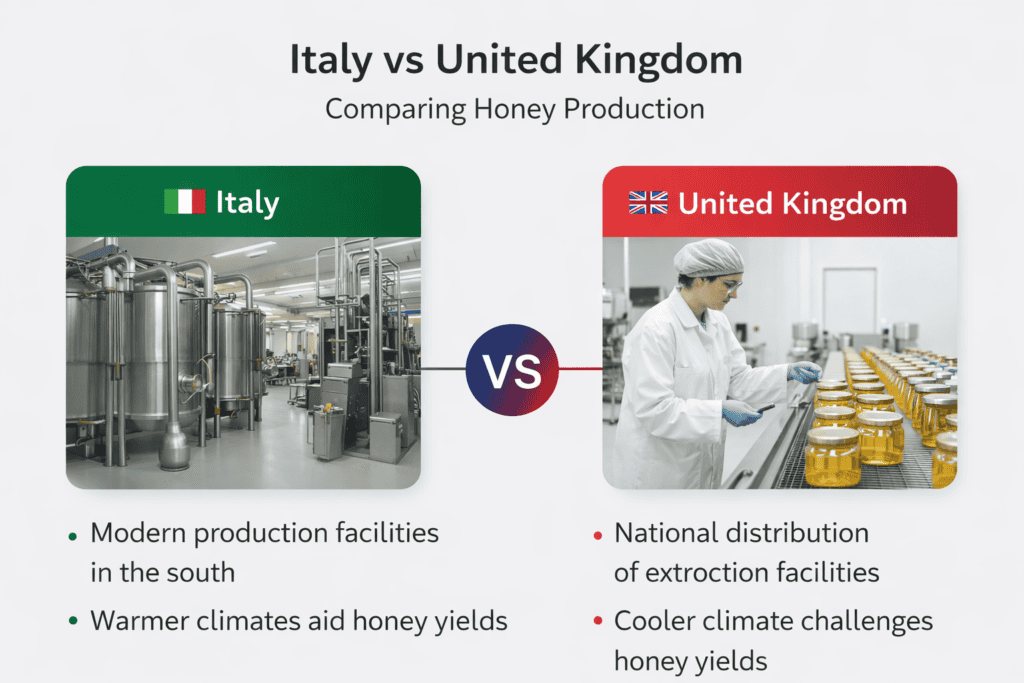
The UK honey model
The UK is a strong honey market with high national consumption, yet domestic production remains modest and heavily influenced by weather variability. A Defra parliamentary response reported that UK output recovered to around 6,500 tonnes in 2019 after earlier declines.
This context is crucial when positioning british honey, because genuine British-origin honey is produced in smaller volumes and is far more sensitive to climate conditions than large-scale imports. As a result, british honey naturally holds a premium status: limited supply, stronger provenance, and higher trust compared with mass-imported blends. For producers and retailers committed to authenticity, these factors make british honey one of the most valued and differentiated honey categories in the market.
The Italy honey model
Italy is one of Europe’s major honey producers, recognised for its diverse floral sources, large migratory beekeeping (“transhumance”), and strong regional identities (acacia, citrus, chestnut, eucalyptus, among others). According to European Commission market reporting, total EU honey production was approximately 285,000 tonnes in 2023 and 282,000 tonnes in 2024.
Within this EU total, Italy typically produces around 20,000–25,000 tonnes per year, placing it among the leading EU honey-producing countries. However, Italian production is highly weather-dependent, and harvest volumes can fluctuate significantly between seasons. In particularly strong years, industry sources may report higher national output, reflecting the natural variability of nectar flows and climatic conditions.
What this means commercially: Italy’s domestic industry tends to have deeper infrastructure (co-ops, migratory fleets, varietal lines). The UK tends to win on local provenance and premium brand storytelling, especially for smaller-batch pure honey.
2) Quantity: why production is so different
UK: lower total volume, high volatility
UK honey output is shaped by:
- Weather timing (spring build-up, nectar flow windows, summer storms)
- Forage continuity (gaps between flows)
- Varroa and disease pressure (colony losses reduce workforce at key moments)
- Scale structure (many small beekeepers; fewer very large operators)
Defra’s statement highlights weather and pests/disease as key drivers affecting UK production levels.
Scientific monitoring work in the UK has also pointed to shrinking yields compared with historic expectations, showing how long-term environmental conditions matter.
Practical result: UK production swings dramatically year to year. A wet spring can reduce nectar flows; a cool summer can shorten the main crop; prolonged rain can stop bees flying during peak bloom.
Italy: higher potential volume, but climate extremes hit hard
Italy’s advantage is geographic diversity:
- Alpine and Apennine zones
- Po Valley agriculture
- Mediterranean coastal and island forage
That diversity can “smooth” national output because different regions flower at different times. But it also creates exposure to heatwaves, drought, and extreme rainfall that can crash certain flows (acacia is famously sensitive to late frosts and rain).
At EU level, the Commission’s honey market reporting underlines how production varies across years and regions, and tracks yields and prices across member states.
Meanwhile, Mediterranean climate patterns (hotter summers, drought risk, intense rain events) are increasingly part of the production story.
Practical result: Italy can produce more—especially in good nectar years—but climate volatility can cause sharp local collapses.
3) “Pure honey” and quality: definitions, tests, and what consumers actually get
The legal foundation: what “honey” is allowed to be
Across Europe, honey quality and labelling are anchored by the EU Honey Directive (and in the UK, closely aligned national rules). The directive sets compositional and labelling principles and addresses issues like filtered honey and transparency.
In England, honey marketing rules are set out in the Honey (England) Regulations 2015.
What “pure honey” should mean in practice
In a scientific and consumer-trust sense, pure honey should mean:
- No adulteration (no added sugar syrups)
- No misleading blending/labelling
- Managed heat exposure (to protect enzymes/aroma, and avoid quality degradation)
- Traceable origin and responsible handling
Common lab checks used in modern supply chains include:
- Moisture content (fermentation risk if too high)
- HMF (Hydroxymethylfurfural) as an indicator of overheating/aging (used widely in quality control systems)
- Diastase activity (enzyme preservation)
- Pollen analysis / authenticity tools (often used in advanced quality programmes)
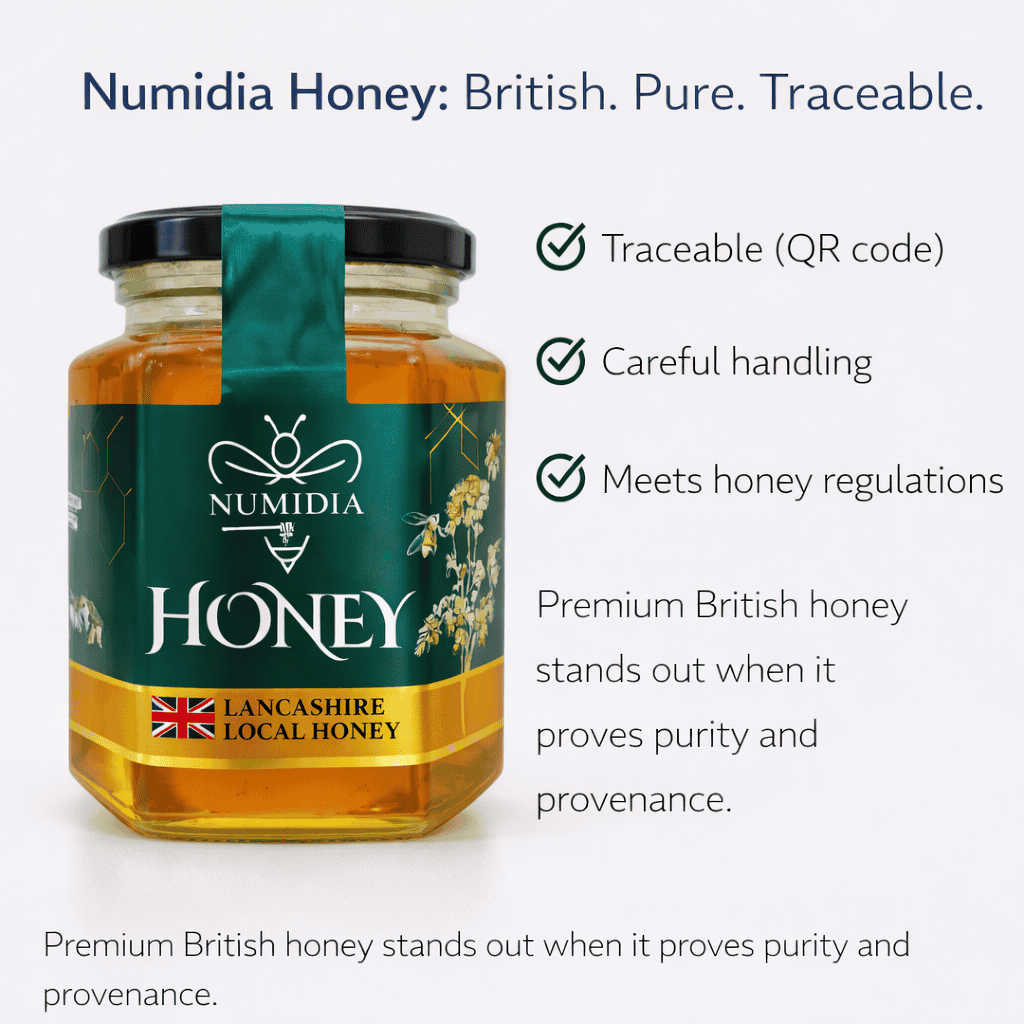
Key point for brands like Numidia Honey: premium british honey wins when it demonstrates traceability + careful handling + honest origin, because the UK market is import-heavy and consumers worry about authenticity.
4) Facilities and labour: machines, extraction systems, and the human factor
UK facilities: lots of small extraction rooms, fewer industrial packers
The UK has many hobbyists and semi-commercial beekeepers who extract in:
- Basic manual extractors and settling tanks
- Food-safe rooms in small units / farm buildings
- Small-batch jarring and labelling set-ups
At the larger end, UK packers and brands often rely on imported bulk honey for mass-market supply (which is separate from the premium local segment). The UK’s policy and market context acknowledges the role of imports in supply.
Human skill dominates in the UK small-scale segment:
- Queen management
- Varroa strategy
- Timing of harvest
- Sensory grading and batch consistency
Italy facilities: stronger co-ops + migratory infrastructure
Italy’s beekeeping has a stronger tradition of:
- Co-operatives and shared extraction centres
- Migratory fleets moving hives to varietal flows
- More standardised varietal separation (acacia vs chestnut vs citrus)
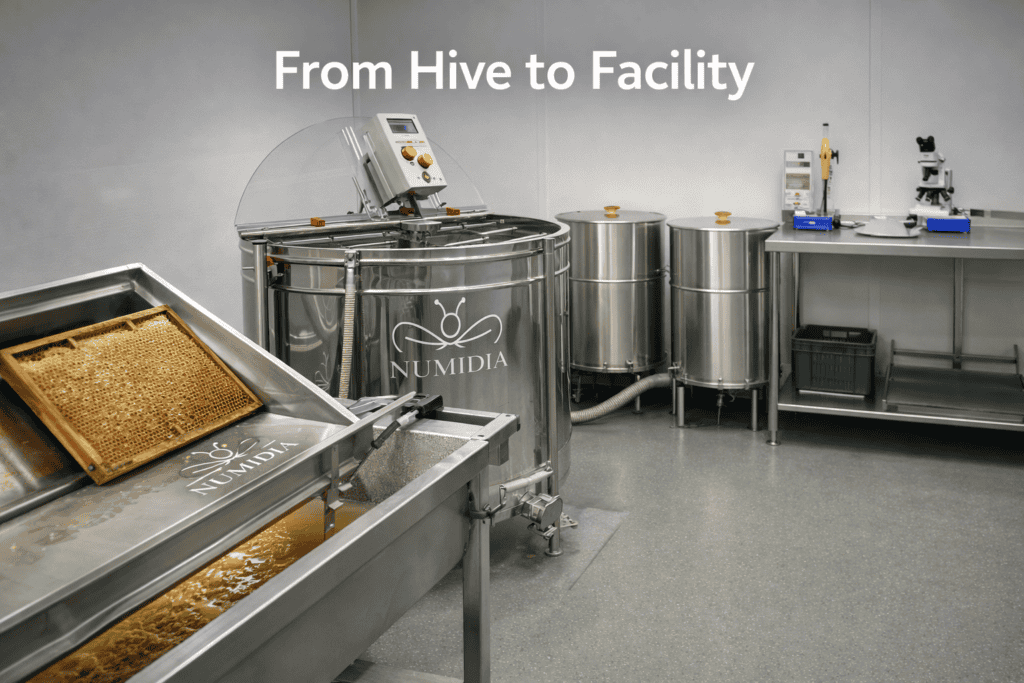
- Investment in stainless systems, warming cabinets (carefully controlled), filtration options, and commercial packing lines
EU market reporting explicitly tracks hives, yields, and price levels, reflecting a more structured commercial data environment.
Human skill is still crucial (queen quality, disease control, transhumance logistics), but Italy’s industry structure makes scaling easier where the economics support it.
5) Government and public support: hobbyists vs commercial operators
UK support: bee health programmes and national coordination
In the UK, one of the most important “supports” isn’t a direct cash grant—it’s biosecurity and training infrastructure.
The National Bee Unit (NBU) and BeeBase provide surveillance, beekeeper registration, disease alerts, training resources, and support for national bee health programmes.
This matters for both hobbyists and commercial beekeepers because disease control protects everyone’s bees in shared landscapes.
The UK also has an “apiculture programme” framework described through BeeBase resources.
What UK beekeepers effectively receive:
- Practical disease guidance and inspection systems
- Education, alerts, and coordinated response capacity
- A national platform (BeeBase) that improves outbreak tracking
Italy support: EU CAP apiculture interventions + national programmes
Italy benefits from EU-level agriculture structures that require member states to include apiculture interventions in CAP Strategic Plans (2023–2027). The European Commission outlines eligible intervention types such as:
- Training/advisory
- Investments (disease control, climate adaptation, restocking, transhumance rationalisation)
- Product and loss analyses
- Hive preservation/increase
- Research and cooperation
- Promotion/marketing and quality enhancement
What Italian beekeepers can access (depending on region and programme):
- Co-funded investment support
- Measures tied to disease management and climate resilience
- Structured national and regional frameworks for the sector
Bottom line:
- The UK system is strongest in bee health governance and practical coordination.
- Italy’s system is stronger in structured sector programmes and investment-style interventions within the EU framework.
6) Weather and forage: the hidden “machine” behind honey quantity and quality
UK weather: mild, maritime… and increasingly unpredictable
The UK’s maritime climate can be good for long foraging seasons, but the real issue is flight days and nectar flow timing. Extended rain during blossom reduces foraging even if flowers exist.
Met Office climate datasets and long-term averages show how rainfall and temperature patterns define the baseline conditions for UK agriculture and forage.
Recent periods of unusually persistent rainfall also illustrate how extreme weather can disrupt nectar windows and colony management.
Italy weather: regional variety + Mediterranean extremes
Italy spans Alpine cold to Mediterranean heat. That creates:
- Many varietal honeys
- Multiple harvest windows
- Migration opportunities
But the trade-off is higher exposure to:
- Drought (reduces nectar secretion)
- Heatwaves (stress colonies, accelerate dearth)
- Intense rain events (destroy blooms, wash nectar, block flights)
General climate summaries reflect the strong seasonal and regional contrasts across Italy.
Quality link to weather:
Weather affects not only yield but also moisture content, aroma compounds, and crystallisation tendency—which is why premium pure honey producers watch harvest timing closely.
7) Market positioning: why “British honey” and “pure honey” are strategic keywords
UK: scarcity supports premium pricing—if trust is high
Because UK production is modest relative to demand, british honey competes less on cheap volume and more on:
- Provenance
- Authenticity signals
- Batch traceability
- Clean, premium packaging
- Education (why crystallisation, runniness, floral variation are normal)
This is exactly where Numidia Honey can win: by positioning as premium British-origin honey with careful handling, strong labelling discipline, and clear storytelling.
Italy: varietal richness supports differentiation
Italy competes with:
- Protected regional identity
- Famous varietals (acacia, chestnut, citrus)
- Strong culinary pairing culture
- Export-ready category knowledge
But Italian producers still face authenticity pressure and climate-driven volatility—so the strongest brands also build trust via traceability and testing.
8) Facilities + quality systems: what “professional and scientific” looks like in practice
Whether in the UK or Italy, a modern premium honey operation tends to share the same “quality architecture”:
- Bee health management
National surveillance matters: the UK’s BeeBase model is a strong example of public infrastructure supporting private producers. - Controlled extraction and settling
- Clean rooms, food-safe surfaces
- Settling tanks to reduce wax/air
- Avoiding excessive heat
- Batch documentation
- Apiary location and harvest date
- Floral notes and moisture checks
- Storage conditions
- Authenticity + degradation checks
HMF testing is commonly referenced as part of broader honey quality control systems.
(Serious operations typically combine multiple checks rather than relying on one indicator.) - Honest labelling aligned with law
EU directive principles and UK regulations define how honey can be presented to consumers.
9) Conclusion: who “wins” and what it means for Numidia Honey
If the question is quantity:
Italy generally has higher production capacity and a stronger commercial structure across diverse regions. EU reporting shows Italy consistently among the leading EU producers and provides a formal tracking framework across hives, yields, and prices.
If the question is premium quality positioning:
The UK is extremely strong for high-trust local food branding, because british honey is scarce relative to demand and consumers are willing to pay for authentic, traceable pure honey.
If the question is “facilities and support”:
- The UK excels in coordinated bee health systems (NBU/BeeBase).
- Italy benefits from EU CAP apiculture interventions that can support investment, climate adaptation, research, and quality programmes.
Where Numidia Honey fits:
Numidia Honey can position itself as the best of the UK model: premium British-origin honey, handled carefully, labelled correctly, and supported by real science (moisture control, storage discipline, and authenticity-aware practices). That’s how you turn “a jar of honey” into a high-value product in a market full of low-cost blends.
- https://numidiakingdom.co.uk/product/numidia-honey-vinegar-250ml/
- https://numidiakingdom.co.uk/product/numidia-wildflower-honey-500g/
- https://numidiakingdom.co.uk/product/28g-honey/
- https://numidiakingdom.co.uk/uk-raw-honey-is-the-market-better-after-brexit/
- https://numidiakingdom.co.uk/why-british-honey-is-naturally-runny-a-scientific-explanation/
- UK Honey Production (Defra / UK Parliament):
https://questions-statements.parliament.uk/written-questions/detail/2020-10-07/100348/ - National Bee Unit / BeeBase:
https://www.nationalbeeunit.com/ - Bee Health Guidance (GOV.UK):
https://www.gov.uk/guidance/bee-health - EU Honey Market Report (European Commission PDF):
https://agriculture.ec.europa.eu/document/download/c04a9774-5ba3-41f5-b256-08396b2888ec_en?filename=market-presentation-honey_spring2024_en.pdf - EU Apiculture Interventions Overview (European Commission PDF):
https://agriculture.ec.europa.eu/document/download/d56e99be-bc25-47ab-88c4-a2cf9b0ea586_en?filename=overview-apiculture-interventions-csp-may-2024_en.pdf - EU Honey Directive (EUR-Lex consolidated):
https://eur-lex.europa.eu/legal-content/EN/TXT/PDF/?uri=CELEX:02001L0110-20140623 - Honey (England) Regulations 2015:
https://www.legislation.gov.uk/uksi/2015/1348 - Met Office Climate Long-Term Averages:
https://www.metoffice.gov.uk/research/climate/maps-and-data/location-specific-long-term-averages/
