British Honey Industry
The Complete Guide to British Honey UK (2026)
British honey has evolved from a simple kitchen staple into a highly scrutinised agricultural product shaped by regulation, sustainability concerns, market pricing pressures, and rising consumer demand for authenticity. In 2026, interest in raw British honey continues to increase as buyers seek transparency, traceability, and minimal processing.
This guide provides a complete analysis of the British honey UK industry, including production trends, regulatory oversight, scientific quality factors, pricing dynamics, honey fraud risks, sustainability challenges, and long-term market outlook. It is designed as a reference resource for consumers, retailers, hospitality buyers, and food professionals.
1. Overview of the British Honey UK Market
The UK honey market consists of three primary segments:
- Domestic British honey production
- Imported honey (EU and non-EU)
- Blended and packed honey products
According to industry data from the National Bee Unit and DEFRA reporting, the UK does not produce enough honey to meet total domestic demand. This creates a dual market where British honey commands a premium, while imported blends fill volume demand.
Key characteristics of British honey UK:
• Smaller-scale production
• Seasonal yield variability
• High traceability
• Strong regulatory framework
• Premium retail positioning
Official oversight bodies include:
Food Standards Agency
https://www.food.gov.uk
National Bee Unit
https://www.nationalbeeunit.com
British Beekeepers Association
https://www.bbka.org.uk
These institutions help maintain quality standards and bee health monitoring within the UK.
Consumers who prioritise traceability and clear origin labelling should choose producers that openly display batch numbers, extraction methods, and country of origin. For example, our Numidia Wildflower Honey 500g demonstrates how small-batch UK honey can be presented transparently with full UK sourcing details.
2. British Honey Production Data and Seasonal Variability
British honey production depends heavily on:
• Weather patterns
• Nectar availability
• Forage diversity
• Colony health
• Beekeeper management practices
Annual yields fluctuate significantly due to rainfall and temperature patterns. A warm, dry spring often produces strong oilseed rape yields, while prolonged rain can reduce nectar flow.
Floral sources commonly contributing to UK honey:
Spring:
• Oilseed rape
• Hawthorn
• Apple blossom
Summer:
• Clover
• Lime
• Borage
• Wildflowers
Late season:
• Heather
Heather honey, in particular, commands higher prices due to its distinctive thixotropic texture and limited regional availability.
Seasonal variability makes British honey less uniform than industrial imports, but this variability is often seen as a sign of authenticity.
3. Raw British Honey: Scientific Composition and Enzyme Activity
Raw UK honey contains naturally occurring components including:
• Fructose and glucose
• Organic acids
• Amino acids
• Trace minerals
• Antioxidants
• Enzymes such as diastase and invertase
Enzyme Sensitivity
Enzymes degrade when exposed to heat above approximately 60°C. Industrial pasteurisation may reduce enzyme activity and alter flavour compounds.
HMF (Hydroxymethylfurfural) is used internationally as an indicator of heat exposure. UK standards limit acceptable HMF levels to maintain product freshness.
Codex Alimentarius standards:
https://www.fao.org/fao-who-codexalimentarius/en/
Raw english honey that is minimally filtered and not overheated retains more natural pollen and enzyme activity.
For a detailed breakdown of processing differences, see our analysis of pure vs processed honey.
4. UK Honey Regulations and Legal Protection
Raw honey UK must comply with compositional and labelling rules defined under national law.
Key regulatory requirements:
• No added sugars
• No syrups
• Defined moisture limits
• HMF thresholds
• Accurate country-of-origin labelling
Government guidance:
https://www.gov.uk/food-labelling-and-honey-rules
The Food Standards Agency enforces food safety compliance.
The National Bee Unit monitors bee health and disease control across England and Wales.
These regulatory systems distinguish British honey from loosely regulated international supply chains.
5. Honey Fraud and Adulteration Risks
Honey fraud remains a global concern. International investigations have identified adulteration involving:
• Rice syrup
• Corn syrup
• Inverted sugar syrups
• Mislabelled origin claims
Raw honey UK is generally considered lower risk due to stronger traceability and regulatory oversight.
The European Commission has also conducted coordinated action against honey fraud:
https://food.ec.europa.eu
Purchasing from transparent British producers reduces exposure to adulterated products.
6. British Honey Price Trends 2026
British honey price 2026 reflects:
• Glass jar cost increases
• Labour expenses
• Reduced domestic yields in poor weather years
• Increased demand for raw British honey
• Premium local sourcing preference
Typical retail range (500g):
£10 – £18 (standard wildflower)
£15+ (specialty, heather, single-origin)
Mini jar retail:
£2.50 – £3.50
Wholesale mini jar pricing:
£1.20 – £2.00
Pricing varies depending on:
• Floral type
• Packaging
• Brand positioning
• Distribution channel
For detailed packaging and mini-format analysis, see our small honey jars UK overview.
Premium pricing reflects limited domestic production and strict regulatory compliance. As an illustration of current UK retail positioning, ourUK honey 500g jar sits within the typical premium range for raw British honey.
7. British Honey vs Imported Honey Blends
Comparison factors:
| Factor | British Honey UK | Imported Blends |
|---|---|---|
| Origin clarity | High | Often mixed |
| Traceability | Strong | Variable |
| Seasonal variation | Yes | Reduced |
| Regulation enforcement | UK law | Depends on country |
| Price | Premium | Budget to mid |
Consumers often prioritise British honey for transparency and local support.
8. Sustainability and Climate Impact on British Honey UK
Sustainability has become one of the most important drivers in the British honey UK market. Consumers increasingly want reassurance that honey production supports biodiversity, pollination, and environmental stewardship.
Pollination and Agricultural Value
Honey bees contribute significantly to UK agriculture by pollinating:
- Fruit crops
- Oilseed rape
- Field beans
- Soft fruits
- Wild plants
The broader ecological value of pollination extends beyond honey production itself. Pollination supports crop yields, biodiversity, and habitat resilience.
Government and environmental agencies continue to promote pollinator-friendly farming schemes. The long-term viability of UK honey production is closely tied to these environmental frameworks.
Climate Variability and Honey Yields
Climate change has introduced new challenges for British honey UK production:
- Unpredictable spring temperatures
- Heavy rainfall during nectar flows
- Drought affecting forage
- Extended cold snaps
Weather variability directly impacts nectar secretion. A poor spring can reduce national honey yield dramatically.
Because English honey relies on seasonal forage, it naturally reflects climate variability. This makes domestic honey production less uniform than imported industrial blends—but also more authentic.
9. UK Beekeeping Challenges and Colony Health
British honey production depends on colony health and beekeeper expertise.
Varroa Mite Pressure
The varroa destructor mite remains a significant challenge in UK apiaries. Beekeepers must monitor and manage infestation to protect colony viability.
The National Bee Unit provides guidance on disease management and surveillance:
https://www.nationalbeeunit.com
Disease Monitoring and Biosecurity
UK beekeepers operate under structured disease reporting systems. Surveillance programmes aim to prevent the spread of:
- American foulbrood
- European foulbrood
- Exotic pests
Strong biosecurity measures reinforce trust in British honey UK.
10. Export Potential of British Honey
Although domestic demand remains high, British honey has niche export potential in premium markets.
Why International Buyers Value raw British Honey
Premium international buyers often seek:
- Single-origin honey
- Strict regulatory compliance
- Transparent sourcing
- Clean environmental reputation
The Department for Business and Trade promotes UK agricultural exports:
https://www.great.gov.uk
However, total export volumes remain limited compared to large-scale honey-producing nations.
English honey’s strength lies in quality, not volume.
11. British Honey in Hospitality and Retail
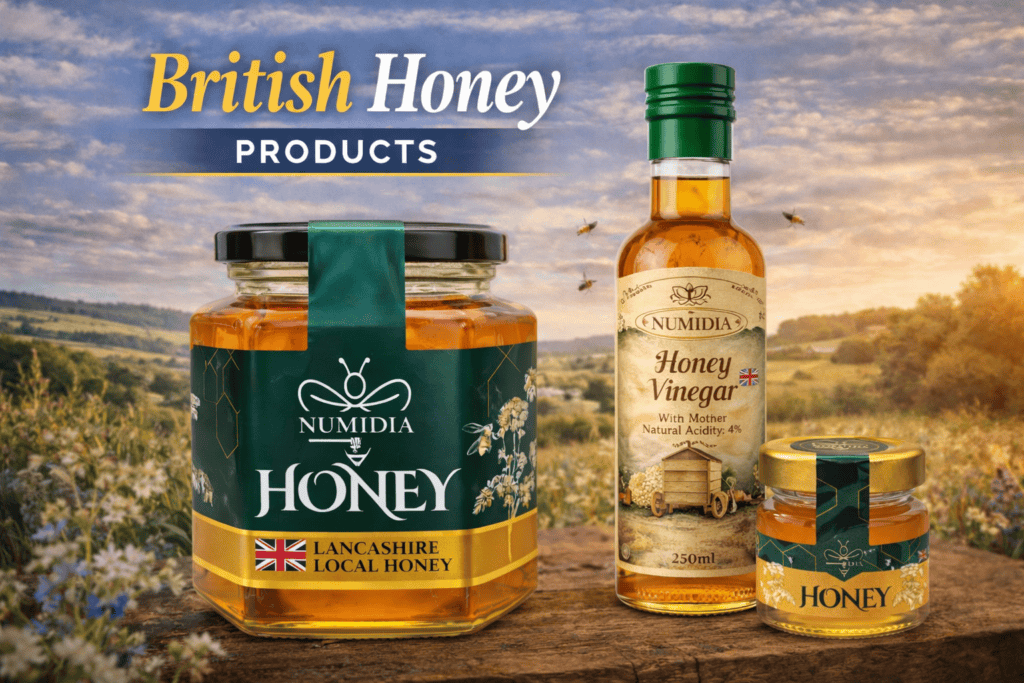
Mini jar formats are increasingly used in weddings and boutique hotels. Our 28g mini honey jars are an example of how raw British honey is adapted for gi
Raw British honey UK has expanded into multiple commercial sectors:
Hospitality Sector
Hotels and boutique B&Bs increasingly prefer local UK honey due to:
- Premium presentation
- Sustainability positioning
- Reduced plastic packaging
- Support for local producers
Mini jars have become common in:
- Breakfast buffets
- Afternoon tea service
- Luxury hampers
For format analysis, see our small honey jars UK overview.
Weddings and Corporate Gifting
Mini jar formats of raw honey are widely used as:
- Wedding favours
- Corporate gifts
- Seasonal hampers
- Tourist souvenirs
The appeal lies in:
- Portion control
- Elegant packaging
- Perceived authenticity
Beyond traditional jars, local pure honey is also used in fermentation-based products. Our raw honey vinegar showcases how local honey can be transformed into value-added artisan products.
12. Scientific Research and Honey Quality Indicators
Academic research highlights key markers used to evaluate honey quality.
Moisture Content
High moisture increases fermentation risk. UK standards define acceptable limits.
HMF (Hydroxymethylfurfural)
HMF increases when honey is overheated or stored poorly. UK and international standards limit acceptable HMF levels.
Pollen Analysis
Pollen content assists in verifying floral and geographical origin.
European Commission research initiatives continue to monitor honey authenticity:
https://food.ec.europa.eu
Codex international standards define compositional benchmarks:
https://www.fao.org/fao-who-codexalimentarius/en/
These frameworks reinforce confidence in regulated British honey UK.
13. Long-Term Outlook for raw British Honey UK (2026–2030)
Industry trends suggest:
- Continued demand for raw UK honey
- Premium pricing stability
- Increased scrutiny of imports
- Greater emphasis on sustainability
- Expansion of direct-to-consumer sales
However, challenges remain:
- Climate unpredictability
- Forage decline
- Rising production costs
- Competition from cheaper imports
UK honey’s future strength lies in transparency, traceability, and regulatory compliance.
14. Advanced FAQ: British Honey UK
What defines British honey legally?
British honey must be produced within the UK and comply with national compositional and labelling standards.
Is raw British honey healthier than processed honey?
Raw English honey retains more natural enzymes and pollen due to minimal heat exposure.
Why is raw British honey more expensive?
Limited domestic production, labour costs, glass packaging, and regulatory compliance contribute to premium pricing.
Does UK honey crystallise?
Yes. Crystallisation is natural and common in raw British honey.
Is imported honey unsafe?
Not necessarily, but traceability and regulatory enforcement may vary by origin.
How can I verify honey authenticity?
Look for named producers, clear origin statements, and compliance with UK labelling rules.
Does climate change affect British honey?
Yes. Weather patterns directly impact nectar flow and annual yields.
Is British honey organic?
Not all British honey is organic. Organic certification requires additional compliance.
Can UK honey be exported?
Yes, but volumes remain limited and premium-focused.
What is the difference between local honey and British honey?
Local honey refers to regional production, while British honey refers to national origin.
15. Internal Authority Linking Structure
To strengthen topical authority:
From this pillar, link to:
- pure vs processed honey
- small honey jars UK
- honey price analysis
- beekeeping challenges article
- honey vinegar guide
Then from each of those pages, link back to:
“British Honey UK Industry Guide”
This creates a structured content cluster that strengthens domain authority.
Why British Honey UK Remains Essential in 2026
British honey UK is more than a simple pantry product. It represents regulated food standards, seasonal agriculture, and the long-standing expertise of UK beekeepers. In today’s global market, concerns about adulteration and unclear origin labelling are growing. As a result, British honey stands out for its transparency and traceability.
Rising Demand for Raw British Honey
Over the past few years, consumer awareness has increased significantly. Consequently, interest in raw local honey continues to grow. Buyers now look for minimally processed honey that retains natural enzymes and floral character.
For example, understanding the difference between heating and filtration helps consumers make informed choices. To learn more about this topic, see our guide to pure vs processed honey.
Pricing Reflects Quality and Limited Supply
Pricing trends also show a clear shift toward premium products. Although imported blends dominate supermarket shelves, raw honey commands higher retail value. This is mainly due to limited domestic production and rising packaging costs.
Moreover, gifting and hospitality demand have influenced format pricing. For a detailed breakdown of mini jar formats and wholesale trends, explore our analysis of small honey jars UK.
Sustainability and Production Challenges
From an environmental perspective, British honey production supports pollination and biodiversity. However, climate variability continues to create uncertainty. In addition, colony health remains a critical factor for long-term production stability.
We examine these pressures in greater depth in our article on beekeeping challenges in the UK, which outlines the realities facing modern apiaries.
Product Innovation Beyond Traditional Jars
At the same time, innovation within the honey sector is expanding. Honey is no longer limited to standard jar formats. Instead, value-added products are gaining popularity, especially among health-conscious consumers.
For instance, fermented honey products have entered the market. Our overview of raw honey vinegar explains how British honey is used in fermentation-based applications.
What Will Shape the Future (2026–2030)
Looking ahead, several factors will influence the British honey UK market:
• Strong regulatory enforcement
• Sustainable forage management
• Clear and transparent labelling
• Continued consumer education
• Ongoing support for domestic beekeepers
Therefore, maintaining trust will be essential.
For readers who wish to see practical examples of traceable production standards, browse our curated english honey collection.
Final Perspective
Ultimately, English honey is not defined only by geography. Instead, it is defined by integrity. As regulatory oversight strengthens and consumer expectations rise, raw english honey will continue to be shaped by authenticity, transparency, and environmental responsibility.
Related British Honey Resources and Further Reading
Understanding processing methods is essential when evaluating quality. To explore how heating, filtration, and blending affect nutritional value and authenticity pure vs processed honey
Packaging formats also influence purchasing decisions, particularly in the gifting and hospitality sectors. For a full market breakdown of mini formats and wholesale trends, see our guide to small honey jars UK .
British honey production depends heavily on colony health and environmental stability. For a deeper look at the pressures facing modern apiaries, explore our analysis of beekeeping challenges in the UK .
Honey innovation now extends beyond traditional jar formats. To understand how english honey is used in fermentation and functional products, read our overview of raw honey vinegar .
For readers who wish to see practical examples of traceable UK production standards in action, browse our curated British honey collection .
