Uncategorized
Quality Evaluation: British Honey and Honey from North Africa
Introduction: why this comparison matters now
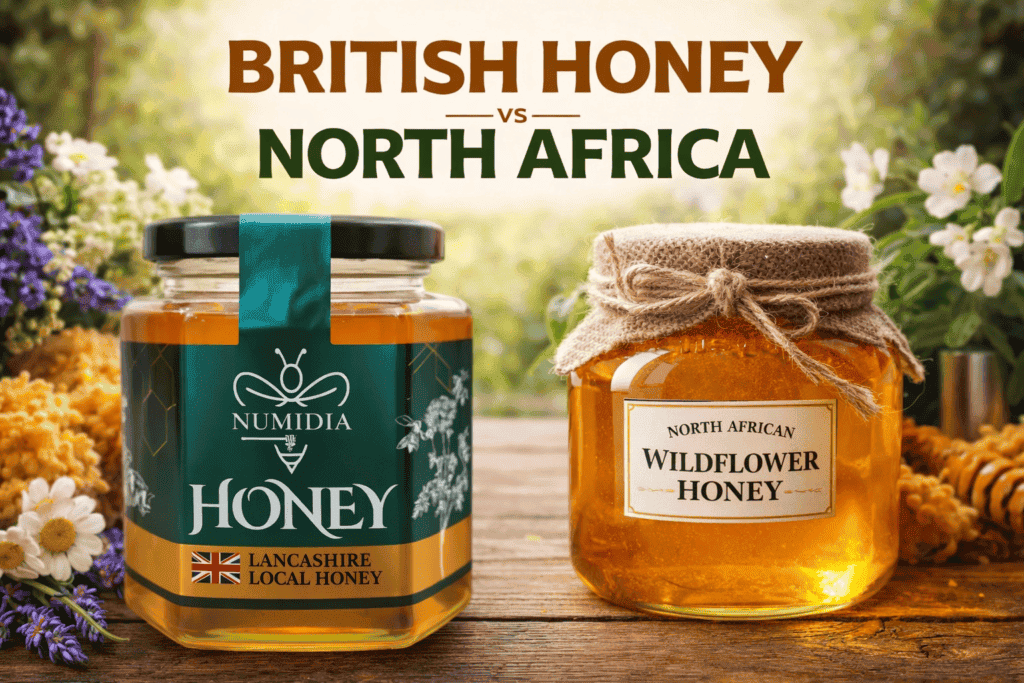
The debate around British honey has intensified in recent years as UK consumers demand transparency, authenticity, and verifiable purity in the products they buy. At the same time, global competition—especially from North African producers—continues to grow, reshaping how retailers and packers source honey for the UK market. The question is no longer just about price; it is about true pure honey, reliable quality standards, and the facilities behind the product.
While the UK relies heavily on imports despite having a strong reputation for high-quality, well-regulated honey production, North Africa presents a very different landscape: larger-scale output in some countries, highly diverse floral environments, and a mix of traditional and modern processing systems. Understanding these differences is essential for anyone working in the honey market—whether producers, packers, buyers, or premium brands like Numidia seeking to position themselves in an increasingly competitive space.
This article compares the UK and North Africa in a practical way:
- Quantity: how much honey is produced, and how much is imported.
- Quality systems: what “pure honey” means under standards and regulations.
- Facilities: extraction rooms, processing, packing, testing, and traceability.
- Market structure: who produces, who packs, and where competition really happens.
- What it means for Numidia: how a premium UK brand can position confidently.
1) Production volume: UK output vs North Africa scale
UK: a net-import market
Official UK parliamentary answers have cited UK honey production at around 6,500 tonnes in 2019.
But UK demand is far larger than domestic supply. Industry sources used by beekeeping organisations note that the UK imported about 50,917 tonnes in 2023 (International Trade Centre data referenced by beekeeping bodies).
That import dependence is also reflected in trade/market analysis: the UK is described as not a major producer, supplying only a minority share of what it consumes.
What that means: The UK honey “market” is mostly a packing + retail market, not a production market. Competition is often decided by sourcing, blending, testing, and branding—not only by beekeeping.
North Africa: mixed scale, with Egypt as the heavyweight
For North Africa, the numbers vary significantly by country and year. FAO reporting for the region gives a useful snapshot for 2020:
- Morocco: ~8,334 tonnes
- Algeria: ~5,377 tonnes
- Tunisia: ~3,645 tonnes
- Libya: ~764 tonnes
Egypt is in a different bracket. FAO regional reporting describes Egypt as producing about 30,000 tonnes annually, with ~2.5 million beehives and substantial livelihood support.
What that means: Some North African countries sit in the same broad production range as the UK (thousands of tonnes), while Egypt can exceed the UK by several multiples. The competitive dynamic is not “UK vs one country,” but UK vs a region with very different production models.
2) “Pure honey” is not marketing — it’s chemistry + rules
In the UK and Europe, honey is legally defined and regulated (including naming rules such as blossom honey, comb honey, drained honey, filtered honey, baker’s honey, etc.). The UK framework is set out in The Honey (England) Regulations 2015.
The science signals used worldwide
Two of the most widely used quality indicators—because they react to heat and storage—are:
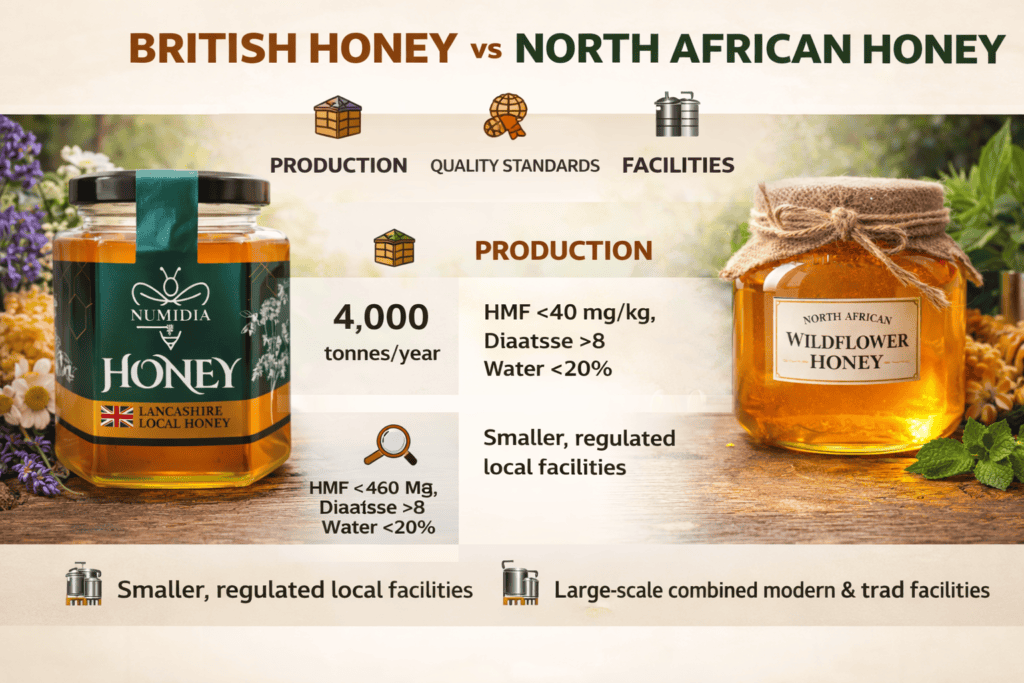
- HMF (Hydroxymethylfurfural): increases with heating and aging; for most honey, a common maximum is 40 mg/kg under major standards.
- Diastase activity (enzyme activity): typically must not fall below 8 Schade units for most honeys (with limited exceptions).
The UK regulations include these kinds of thresholds (including moisture limits and quality parameters).
Globally, the Codex Standard for Honey is a reference point used across many supply chains.
Practical takeaway: if a honey brand wants to claim pure honey, the strongest proof is consistent quality data (moisture, HMF, diastase, etc.) plus traceability—especially important in markets that rely heavily on imports.
3) Facilities: where quality is protected (or lost)
Typical UK “facility reality”
UK beekeeping is diverse:
- hobbyists with small extraction setups,
- semi-commercial beekeepers with dedicated honey rooms,
- commercial producers and—very importantly—packers who handle large volumes of imported honey.
The tightest quality outcomes usually come from:
- Clean extraction rooms (washable surfaces, controlled humidity),
- Low-heat handling (gentle liquefaction only when needed),
- Fast filtration that doesn’t strip identity (avoiding extreme filtration),
- Documented batch control: harvest date → extraction date → batch code → jar.
The UK market conversation increasingly includes authenticity, adulteration risk, and the complexity of verifying imported supply chains. The UK Food Standards Agency has published work and context around honey authenticity and risks.
North Africa: two worlds in one region
North Africa includes:
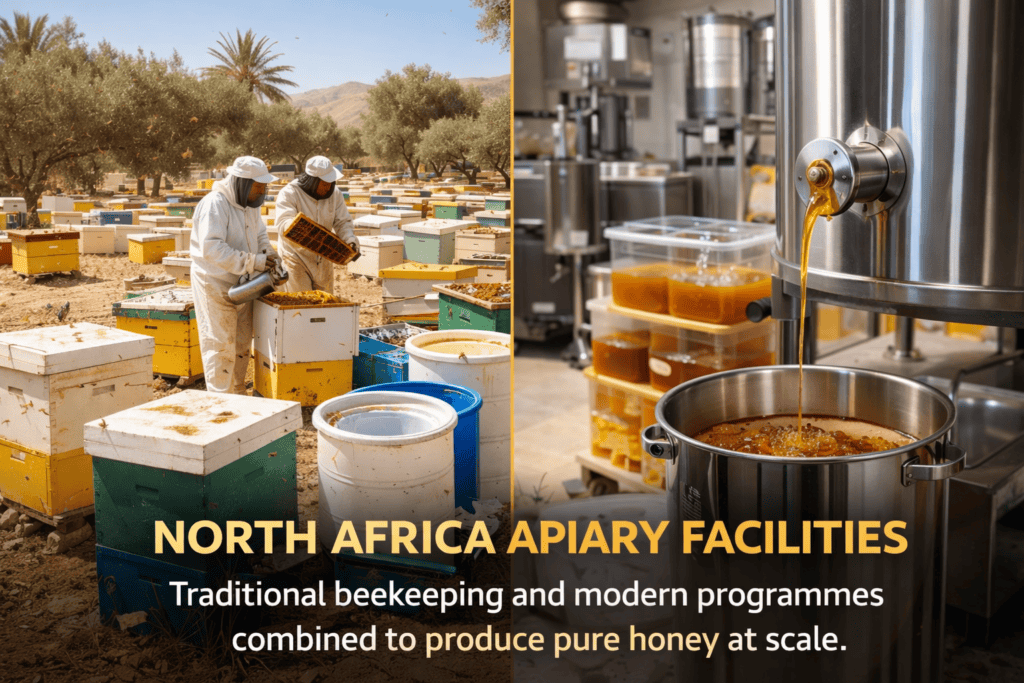
- Traditional beekeeping (smallholders, local markets, minimal processing),
- Organised development programmes (training, breeding centres, better equipment, more standardised handling).
FAO reporting describes examples like Morocco’s growth in beekeepers and production, and structured projects supporting bee breeding and sector assessment in the Maghreb.
Facility gap that matters most: not “modern vs old,” but standardisation.
- In highly standardised chains, moisture control, storage temperatures, and batch testing are consistent.
- In informal chains, quality can still be excellent—but variability rises, and documentation is thinner.
4) Quality differences: UK terroir vs North African diversity
“Quality” is not one thing. It includes:
A) Floral source and flavour complexity
- UK honey often reflects seasonal blends (spring blossom → summer wildflowers), with strong regional character.
- North Africa can range from coastal flora to mountain zones to arid-region forage. That range can produce very distinctive sensory profiles.
B) Moisture control
Moisture is a critical quality variable. Too high can increase fermentation risk; too low can improve stability. UK legal/standard limits commonly reference 20% moisture for most honey categories, with exceptions for specific types like heather.
C) Heat history and freshness
Heat leaves fingerprints—especially in HMF and diastase. Codex/UK-aligned thresholds help prevent overheated, degraded honey being sold as standard table honey.
Bottom line: UK honey often wins on traceability and tight handling when it’s producer-packed. North African honey can compete strongly on unique floral identity and volume in some countries—especially where programmes improve practices.
5) Market competition: where the UK battle is really fought
Because the UK imports far more honey than it produces, most competition happens in four arenas:
- Shelf trust (authenticity + origin clarity)
- Pricing pressure (import blends vs premium local jars)
- Brand story (regional identity, beekeeper credibility, awards)
- Proof (lab standards + transparent batch control)
This is exactly where Numidia can compete powerfully: not by trying to be the cheapest, but by being the clearest, cleanest, and most gift-worthy British honey brand—while still meeting the consumer’s expectation of pure honey supported by standards.
6) Where Numidia fits as a competitor in the UK
Numidia can position as a premium British honey + pure honey benchmark by focusing on:
A) “Proof-led premium”
- Publish a simple “quality panel” per season: moisture range, HMF compliance, handling notes.
- Use batch codes that map to harvest windows and regions.
B) “Local honey, but modern”
Local doesn’t mean small-thinking. It means:
- regional sourcing,
- transparent beekeeper story,
- consistent standards like a luxury food brand.
C) “Facilities-forward storytelling”
A short behind-the-scenes story converts sceptical shoppers:
- extraction room cleanliness,
- settling tanks,
- controlled storage,
- packing discipline.
That kind of content sells trust, not just taste.
British Honey Industry
https://numidiakingdom.co.uk/category/british-honey-industry/
British Honey
https://numidiakingdom.co.uk/category/pure-honey/
British Honey
https://numidiakingdom.co.uk/category/local-honey/
✅ 1. UK Honey Production – UK Parliament (Official Data)
https://questions-statements.parliament.uk/written-questions/detail/2020-10-07/100348
✅ 2. FAO – North Africa Honey & Beekeeping Figures
https://www.fao.org/neareast/news/details/buzzing-with-excitement–celebrating-world-bee-day-2024/en
✅ 3. UK Honey Regulations – The Honey (England) Regulations 2015
https://www.legislation.gov.uk/uksi/2015/1348
✅ 4. Codex Standard for Honey (Global Quality Standards: HMF, Diastase, Moisture)
✅ 5. FSA – UK Honey Authenticity & Testing (Optional Strong Extra Link)
