British Honey Industry
The Hidden Truth Behind Local Honey’s Amazing Journey
Local honey is more than a natural sweetener. It is a story of bees, seasons, landscapes, and the dedication of beekeepers who work with nature rather than against it. When you choose Raw Honey UK, you support your community, protect biodiversity, and enjoy a flavour that reflects the flowers of your region. To help you appreciate this journey, this article explains exactly how our honey travels from the hive, through careful extraction, and finally into your home.
Learn more about regulations and production standards in our completeo British Honey UK report
1. Life Begins Inside the Hive
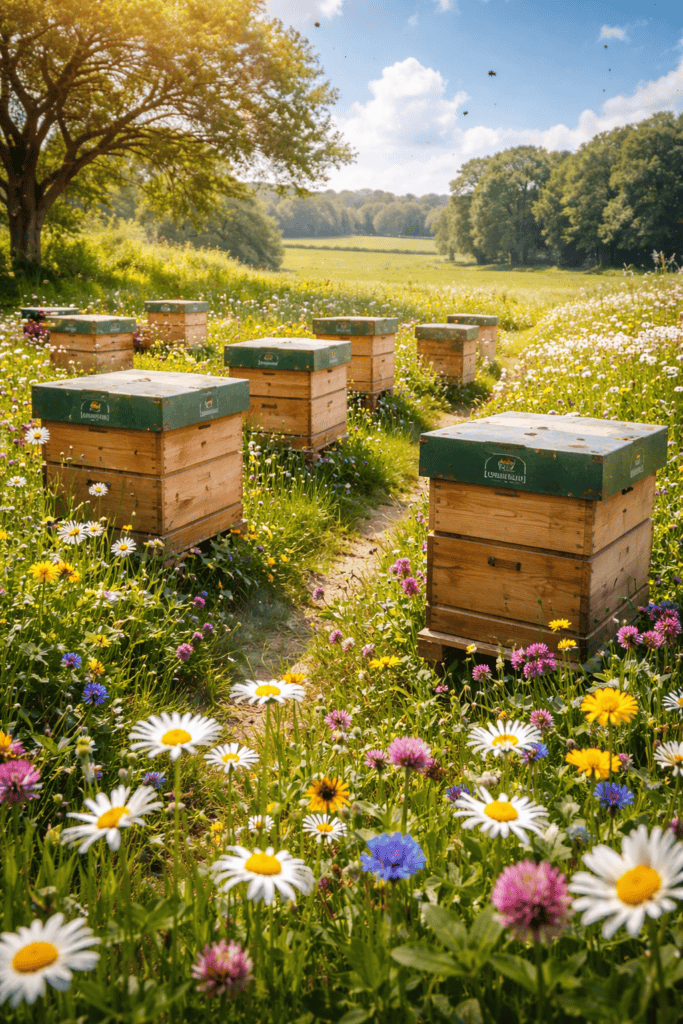
The journey of local honey starts with the bees themselves. Inside the hive, thousands of bees work in harmony. Each one plays a vital role. The queen lays eggs, worker bees gather nectar, and guard bees protect the colony. Because bees depend on the local environment, the flavour of local honey reflects the nearby landscape.
Even during early spring, bees begin collecting nectar from dandelions, willows, and hawthorn. As the season progresses, they visit clover, bramble, lime trees, and wildflowers. These plants shape the taste of our honey, giving it a unique regional identity. According to the British Beekeepers Association, healthy forage is essential for producing high-quality honey (external link: https://www.bbka.org.uk).
Meanwhile, our team monitors bee health carefully. We check brood frames, ensure the colony has space, and make sure the bees have enough food. Because we avoid harsh chemicals and unnecessary stress, the bees produce honey naturally and steadily.
During your visit to our About Us page, you can read more about how Numidia Kingdom supports sustainable beekeeping practices (internal link: https://numidiakingdom.co.uk/about-us/).
2. Foraging: How Bees Gather Nectar
Next, the bees begin their search for nectar. They travel across fields, gardens, and hedgerows, sometimes covering more than three miles in a single trip. Each bee carries nectar in a special stomach, returning to the hive with every drop.
Inside the hive, the nectar is passed from bee to bee. As this happens, enzymes transform the nectar into honey. Gradually, the bees reduce moisture by fanning their wings, which thickens the honey until it reaches the perfect consistency.
Additionally, flowers change with each season. As a result, every batch of local honey tastes slightly different. These natural variations give our honey character. Unlike supermarket blends, our honey is never mixed with imported products to create uniformity. Because of this, our customers enjoy an authentic and local experience.
3. Harvesting the Local Honey Frames
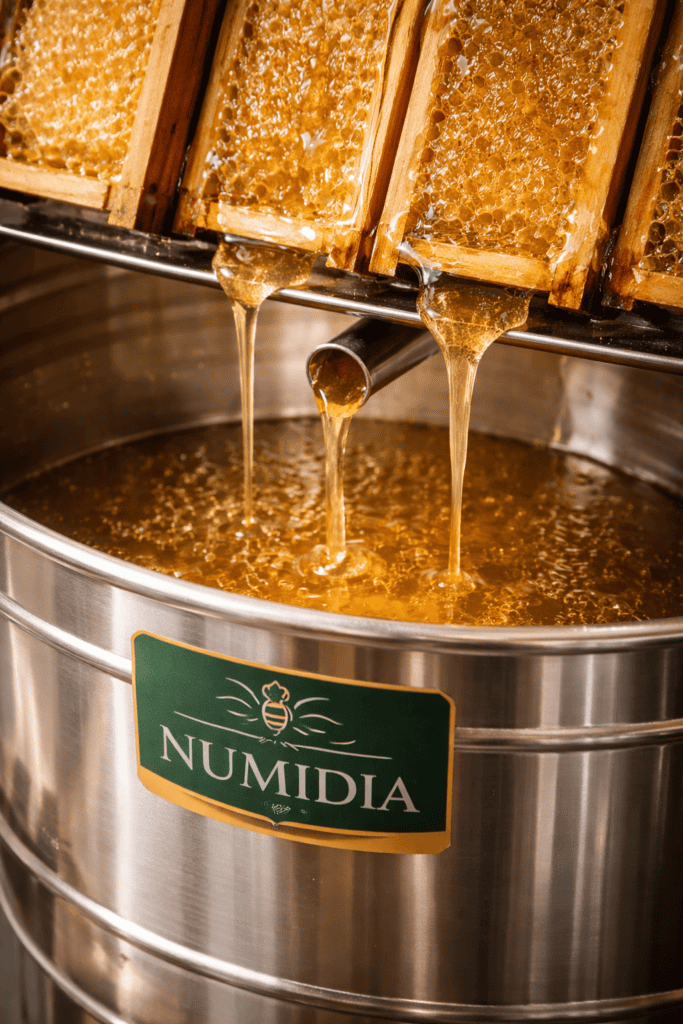
Once the bees cap the honeycomb with a thin layer of wax, the honey is ready for harvest. Our beekeepers remove only fully capped frames. This ensures that every jar contains mature, low-moisture honey with a stable shelf life.
After gently brushing bees away, the frames are taken to our extraction room. As part of our commitment to food safety, we follow guidance from the National Bee Unit to maintain hygiene standards (external link: https://www.nationalbeeunit.com).
Inside the extraction room, the wax caps are removed. Then, the frames are placed into a stainless-steel extractor. When the drum spins, centrifugal force pulls the honey out of the comb. Because our extraction method is gentle, the honey keeps its natural enzymes, aromas, and nutrients.
If you’d like to see how this honey is later paired with our Numidia Honey Vinegar 250ml in recipes, visit our product page (internal link: https://numidiakingdom.co.uk/product/numidia-honey-vinegar-250ml/).
4. Filtering Without Removing Goodness
Filtering is an important step, yet we keep it simple. We only remove large wax particles or bits of propolis that may remain after extraction. We never use ultra-filtration, a process that removes pollen and beneficial enzymes. Because pollen proves the origin of honey, keeping it ensures that your local honey remains truly local.
Furthermore, filtration helps with clarity without compromising the honey’s natural qualities. Whether the honey crystallises quickly or slowly depends on the floral source. Crystallisation is normal and natural. It is one of the best signs that your honey is raw and unprocessed.
5. Settling the Local Honey Before Bottling
After filtering, the honey is placed into settling tanks. This allows tiny air bubbles to rise to the top. As the honey rests, it becomes smooth and even in texture. This natural resting period keeps the honey’s flavour intact.
The settling process also gives us time to prepare jars and labels. For example, our Numidia Wildflower Honey 500g jar is designed to showcase the golden colour of local honey (internal link: https://numidiakingdom.co.uk/product/numidia-wildflower-honey-500g/). Many customers comment that the hexagonal shape reflects the structure of honeycomb, making it both practical and beautiful.
6. Bottling with Care and Precision
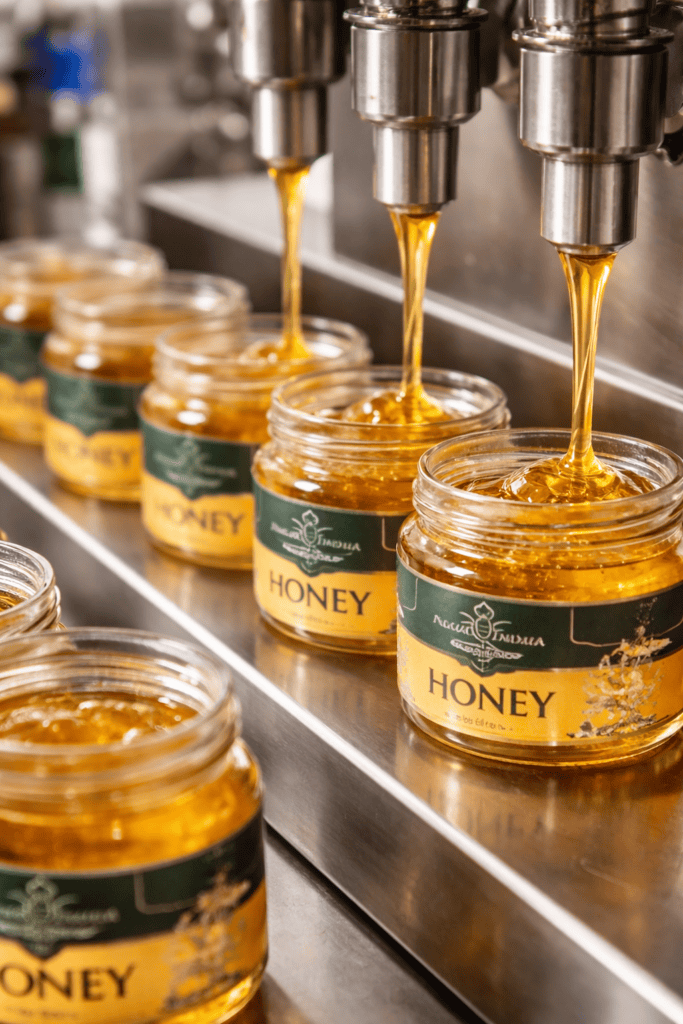
When the Raw Honey UK is ready, we begin bottling. Every jar is cleaned, dried, and inspected before filling. Our bottling equipment ensures consistency and avoids contamination. Because we bottle in small batches, we maintain full control over quality.
Each jar is sealed tightly to protect the Raw Honey UK from moisture. Raw Honey UK naturally resists spoilage, but proper sealing preserves its freshness. After sealing, we label the jars by hand. Our labels include the batch number, region, and floral origin, giving customers full transparency.
Additionally, we follow UK labelling rules, which you can read about on the UK Government website (external link: https://www.gov.uk/food-labelling). Clear labelling helps build trust and ensures you receive genuine local honey.
7. Delivering Fresh Local Honey to Your Home
Finally, the journey ends at your table. Whether you enjoy local honey in tea, breakfast bowls, desserts, or cooking, you taste the result of months of teamwork between bees and beekeepers.
Because many customers also enjoy smaller servings, we offer Numidia Mini Honey Jars 28g Raw Honey UK, which are ideal for hotels, cafés, and gift boxes (internal link: https://numidiakingdom.co.uk/product/numidia-honey-28g-mini-jar/). These jars carry the same quality as our larger ones, just in a convenient portion.
Moreover, local honey supports your community. When you choose honey from a nearby apiary, you help maintain bee populations, protect pollination, and strengthen local agriculture. As the Soil Association notes, supporting natural farming methods benefits the environment (external link: https://www.soilassociation.org).
Conclusion
The journey of local honey or Raw Honey UK as other people called is a remarkable cycle of nature, care, and craftsmanship. Every jar reflects the flowers of Lancashire, the dedication of beekeepers, and the natural hard work of bees. From nectar gathering to hive care, extraction, bottling, and final delivery, local honey travels through many hands and wings before it reaches your home.
When you choose Numidia Kingdom, you choose authenticity, sustainability, and a flavour you can trust. Your support helps protect bees, encourage biodiversity, and keep traditional beekeeping alive.
